EV Charging Stations Map and Tips for Sri Lanka in 2026
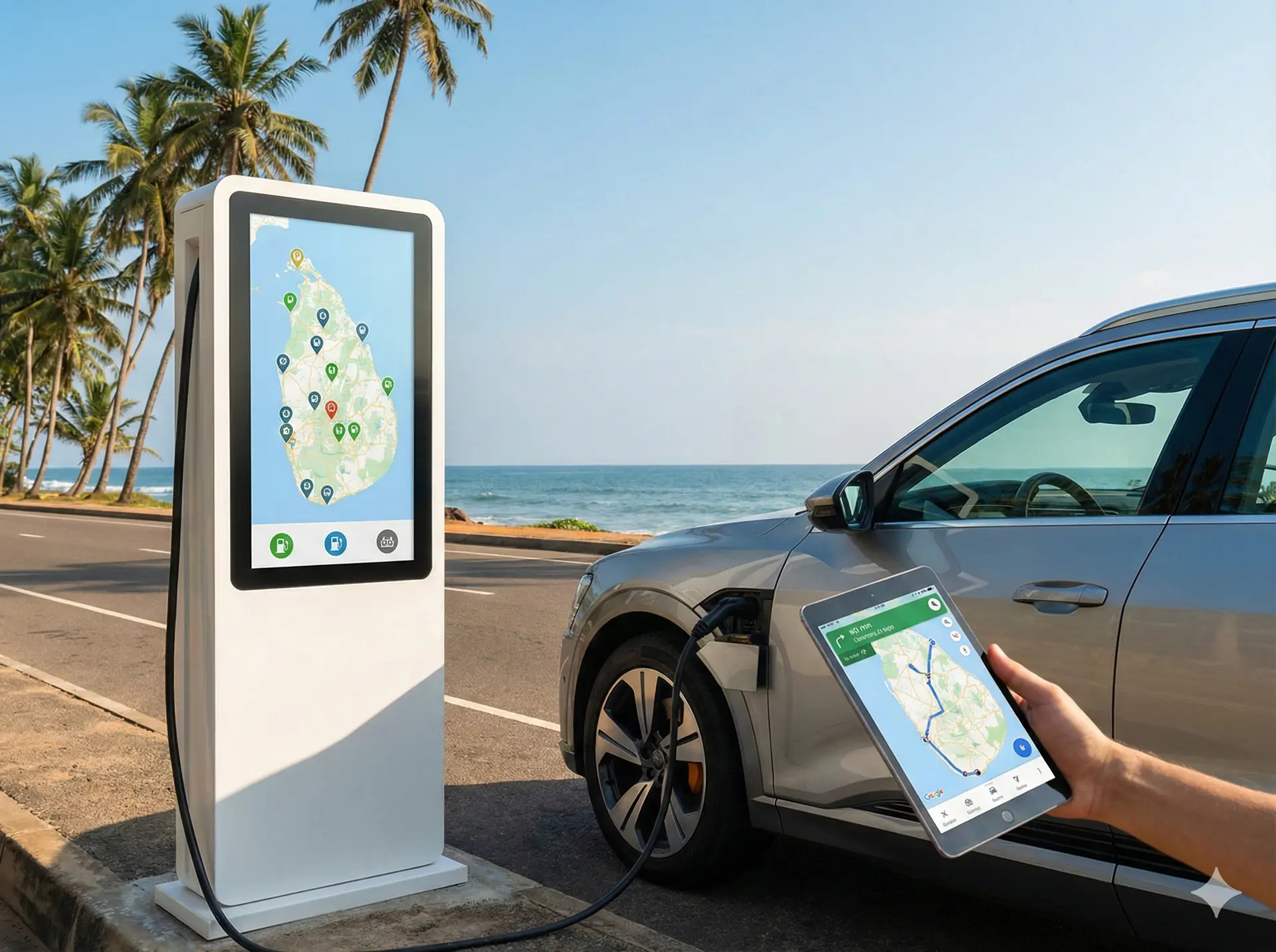
Discover where to charge your EV across Sri Lanka with maps, costs, and practical tips for 2026's expanded charging network.
The Lankawebsites editorial team curates, fact-checks, and updates guides on personal finance, property, health, immigration, legal, business, and lifestyle topics relevant to Lankawebsites readers. Articles are produced with AI assistance and reviewed by the editorial team before publication.
Sri Lanka's electric vehicle landscape has transformed dramatically, and by 2026, we're seeing a robust charging infrastructure that makes EV ownership more practical than ever. With over 600 strategically positioned chargers across the island and multiple operators competing to serve the growing EV community, finding a charging station is no longer a barrier to going electric . Whether you're commuting in Colombo, exploring the hill country, or cruising down the southern coast, understanding where to charge and how to optimise your charging experience is essential for every EV driver.
Understanding Sri Lanka's EV Charging Network
The charging infrastructure in Sri Lanka is primarily concentrated in major urban centres and tourist destinations, with networks operated by several key players . ChargeNET, established by Vega Innovations, operates the largest network with over 600 chargers island-wide, covering residential areas, apartments, restaurants, hotels, supermarkets, shopping malls, fuel stations, and corporate offices . The Ceylon Electricity Board (CEB) and Lanka Electricity Company (LECO) also operate public charging networks, with LECO partnering with eMotion to build its charging infrastructure . Additionally, private operators including motor vehicle importers and commercial establishments have installed charging points to serve their customers .
The network density varies significantly by region, with Colombo and suburbs hosting the highest concentration of chargers, including fast-charging options . Major cities like Kandy, Galle, and Negombo have growing networks, whilst tourist hubs such as Ella, Sigiriya, and locations along the south coast offer charging facilities, often at hotels and guesthouses . The Southern Expressway and main inter-city roads are gradually being equipped with fast chargers to support long-distance travel .

Finding EV Charging Stations: Essential Maps and Apps
Several platforms have emerged to help drivers locate charging stations across Sri Lanka. WAC Charge Map offers a free, community-powered interactive map specifically designed for Sri Lankan EV drivers, allowing users to search by city, district, or charger type, and even save favourite locations . SriEV provides a comprehensive directory filtering by charging type, province, or city, displaying all stations on an interactive map . EVCircle offers real-time availability, booking, and payment capabilities through a mobile app available on both iOS and Android platforms .
For a broader perspective, the EV Club Sri Lanka maintains a detailed list of normal and rapid charging stations across the island . Global platforms like PlugShare also provide coverage for Sri Lanka, featuring user reviews and real-time updates from the community . The Public Utilities Commission of Sri Lanka (PUCSL) maintains an official map of approved charging stations, ensuring all listed locations meet regulatory standards for safety and quality .
Types of Charging and What to Expect
Level 2 AC Charging
Level 2 AC chargers operate at 7-22 kW and typically provide 30-100 kilometres of range per hour of charging . These chargers are commonly found at homes (wall boxes), workplaces, shopping malls, and destination locations where vehicles are parked for extended periods . They're ideal for daily top-ups and overnight charging, making them the most practical option for routine use.
DC Fast Charging
DC fast chargers (Level 3) deliver 50-350 kW or more, capable of replenishing 200-1,000+ kilometres of range per hour depending on your vehicle's capabilities . These high-power chargers can bring an EV battery to 80% capacity in just 20-60 minutes, making them essential for long-distance travel . You'll typically find DC fast chargers at major service stations, expressway rest areas, and dedicated EV hubs.
Charging Costs and Tariffs
Understanding charging costs helps you budget effectively for EV ownership. The CEB operates public charging stations with time-of-use (TOU) pricing that varies significantly throughout the day . For DC fast charging at CEB stations, rates are Rs. 50.00 per kWh during day hours (05:30-18:30), Rs. 70.00 per kWh during peak hours (18:30-22:30), and Rs. 30.00 per kWh during off-peak hours (22:30-05:30) . Level 2 AC charging at CEB stations costs Rs. 30.00 per kWh during day hours .
For home charging, domestic users can apply for a TOU tariff through their regional CEB or LECO office, which requires a three-phase, 30A or above power supply and a special meter . Under this scheme, off-peak charging (22:30-05:30) costs just Rs. 13 per kWh, whilst day hours (05:30-18:30) cost Rs. 25 per kWh and peak hours (18:30-22:30) cost Rs. 54 per kWh . LECO's charging network, built by eMotion, offers some of the lowest rates in Sri Lanka, combining affordability with fast AC and DC charging options .
Planning EV Road Trips Across Sri Lanka
Colombo to Kandy and the Hill Country
The route to Sri Lanka's cultural heartland is increasingly EV-friendly. Charging stations are available in key towns including Kandy, Nuwara Eliya, and Ella . Start with a full charge in Colombo, top up in Kandy, look for chargers in Nuwara Eliya, and charge again in Ella . The drives between these towns can be demanding on batteries due to elevation changes, so careful planning based on your EV's range is essential . Many hotels in the hill country now offer charging facilities, providing reliable overnight charging options.
Southern Coastal Route
The picturesque journey from Colombo to Galle, Mirissa, and Tangalle is well-suited for EV travel. The Southern Expressway has charging points, and Galle offers a growing number of stations, including those in hotels around the historic Galle Fort . As you travel further east along the coast, charging options become slightly less frequent, but major tourist towns typically have hotel chargers . Always plan your stops in advance and ensure you have a comfortable buffer range when arriving at your next charging location.
Cultural Triangle (Sigiriya, Polonnaruwa, Anuradhapura)
When heading to the Cultural Triangle from Colombo or Kandy, ensure you start with a full charge . Charging infrastructure here is developing but remains less dense than in major cities or the popular south coast . Look for charging options at your accommodation or in main towns, and plan day trips between sites knowing you'll need to return to your base for charging .
Essential EV Charging Tips for Sri Lankan Conditions
Maximise your EV charging experience with these practical strategies. Always plan ahead and don't wait until your battery is nearly empty to look for a charger . Use charging apps like PlugShare, WAC Charge Map, or operator-specific apps to locate stations and check their status before travelling . Build in a comfortable range buffer—aim to arrive at your next charging stop with reserve capacity rather than pushing your battery to its absolute limit .
Take advantage of off-peak charging whenever possible to minimise costs. If charging at home, utilise the TOU tariff and schedule charging sessions between 22:30 and 05:30 to benefit from the Rs. 13 per kWh rate . When using public chargers, particularly fast chargers, be considerate of other EV drivers who may need to charge—don't overstay once your vehicle reaches sufficient charge . If your accommodation offers EV charging, even slow AC charging overnight can provide a full battery for the next day's adventures .
Be mindful of Sri Lanka's hot climate, which can affect charging speeds and battery performance. Avoid consistently charging to 100% or letting your battery drop to very low levels, as modern EVs perform best when maintained between 20-80% charge for daily use . Factor charging time into your daily itinerary, especially when relying on AC chargers—fast chargers reduce waiting time significantly but may still require 30-60 minutes or more for a substantial charge .
Regulatory Framework and Safety Standards
The Public Utilities Commission of Sri Lanka (PUCSL) plays a crucial role in regulating EV charging centres, ensuring compliance with the highest standards of safety, quality, and accessibility . All Charge Point Operators (CPOs) must obtain an exemption from PUCSL to establish and operate an EV charging centre in Sri Lanka . The PUCSL issued a comprehensive Code of Practice for Charge Point Operators in April 2025, which governs installation, maintenance, and operation of charging stations .
CPOs must comply with all regulations, codes, and guidelines issued by the Commission, including the Code of Practice, Grid Code, Distribution Code, and Electricity Safety regulations . This regulatory framework ensures that EV charging stations operate safely and reliably whilst protecting consumer rights. Only PUCSL-approved charging stations appear on the official map, giving users confidence in the facilities they're using .
The Road Ahead
Sri Lanka's EV charging infrastructure has matured considerably by 2026, transforming electric vehicles from a niche choice into a practical option for daily commuting and island-wide travel. With multiple operators expanding their networks, regulatory oversight ensuring safety standards, and cost-effective charging options available, the barriers to EV adoption continue to diminish. Before embarking on any journey, familiarise yourself with the available charging maps and apps, understand the charging options along your route, and plan with comfortable range buffers. The combination of growing infrastructure, competitive pricing, and improving technology means that range anxiety is becoming a thing of the past for Sri Lankan EV drivers.
Frequently Asked Questions
Sources & References
-
1
chargeNET - Sri Lanka's First & Largest EV Network — chargenet.lk
-
2
EV Charging Network - eShift — eshift.lk
-
3
LECO Charging Network - eMotion Charging — emotion.lk
-
4
Range Anxiety NO MORE! The ULTIMATE Sri Lankan EV Charging Guide — www.slbuilds.lk
-
5
How to Plan an Electric Car Road Trip in Sri Lanka — www.rofi.lk
-
6
WAC Charge Map - Find EV Charging Stations — wacchargemap.com
-
7
SriEV - EV Charging Stations in Sri Lanka — sriev.com
- 8
-
9
Sri Lanka PHEV and EV Charging Stations Map — www.evclub.lk
-
10
PUCSL - EV Charging Regulatory Framework Announcement — www.linkedin.com
-
11
Sri Lankan EV Charging Guide - Charging Levels and Speeds — www.slbuilds.lk
-
12
PUCSL - Government Electricity Tariff Including EV Charging — www.pucsl.gov.lk
-
13
Off-Peak Tariffs to Charge Electric Cars - EV Club Sri Lanka — www.evclub.lk
- 14
-
15
EV Charging Regulatory Framework - PUCSL — www.pucsl.gov.lk
-
16
Code of Practice for EV Charge Point Operators - PUCSL — www.pucsl.gov.lk
Useful Tools
Related Articles
Best Engine Oils for Sri Lankan Roads in 2026: Comparisons and Recommendations
Driving on Sri Lanka's roads means battling heat, humidity, dust from the dry zones, and heavy traffic in Colombo. With temperatures often soaring above 30°C and our tropical climate accelerating engi
Preparing Your Car for Sri Lanka's 2026 Southwest Monsoon
Protect your vehicle from monsoon damage with this comprehensive preparation guide for Sri Lanka's 2026 southwest monsoon season.
Top Mechanics in Colombo for 2026 Car Servicing
Discover Colombo's most trusted mechanics for 2026, from DIMO and Sterling to independent workshops. Get expert tips on choosing reliable car service.
Hybrid vs Petrol Cars: Best Choice for Sri Lanka 2026
Comparing hybrid vs petrol cars in Sri Lanka for 2026. Discover real fuel costs, maintenance expenses, and which option suits your driving needs best.