Top 10 Mistakes Sri Lankans Make Before Going Abroad (That Cost Them Lakhs)

Dreaming of working abroad? Many Sri Lankans lose lakhs of rupees and face visa rejections because they make preventable mistakes before they even apply. From inflating qualifications to submitting fo
The Lankawebsites editorial team curates, fact-checks, and updates guides on personal finance, property, health, immigration, legal, business, and lifestyle topics relevant to Lankawebsites readers. Articles are produced with AI assistance and reviewed by the editorial team before publication.
Dreaming of working abroad? Many Sri Lankans lose lakhs of rupees and face visa rejections because they make preventable mistakes before they even apply. From inflating qualifications to submitting forged documents, these errors can cost you not just money, but years of your life. Here's what you need to know to avoid becoming another cautionary tale.
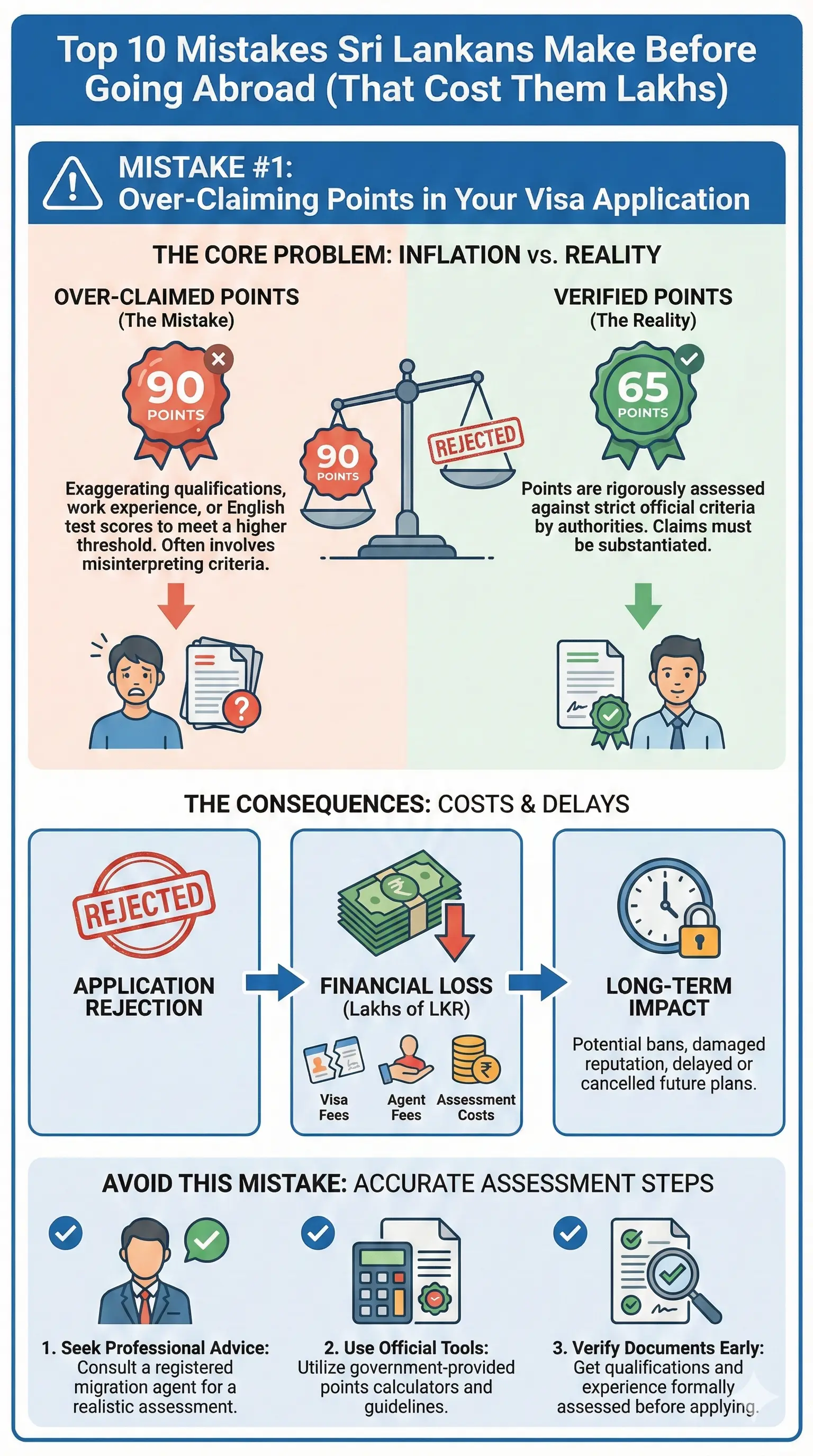
1. Over-Claiming Points in Your Visa Application
The most common mistake Sri Lankan applicants make is inflating their qualifications or experience to boost their visa points. Whether it's claiming a higher English proficiency score than you actually achieved or exaggerating work experience, this rarely goes unnoticed.
In 2026, immigration systems are designed to catch inconsistencies at the visa assessment stage. Case officers now cross-reference your Expression of Interest (EOI) with your actual credentials. If your claimed points don't match your supporting documents, your application gets flagged immediately.
The consequence? A visa refusal under the Public Interest Criterion (PIC) 4020, which can result in a 3-year or even 10-year ban from entering the country.
What to do instead:
- Be honest about your qualifications and work experience from day one
- Get your credentials formally assessed by recognised bodies before applying
- Keep all supporting documents (certificates, reference letters, employment records) ready and consistent
2. Creating Inconsistent Employment Records
Sri Lanka's informal economy makes this tricky. You might have worked as a "Senior Software Engineer" at a small company, but your EPF/ETF records show "Associate" or a completely different title. This inconsistency is a red flag for immigration officers.
In 2026, AI-driven tools cross-check your digital footprint against your claims. Your LinkedIn profile, Facebook history, previous visa applications, and tax records are all scrutinised. If the job titles or employment dates don't align perfectly, it triggers a "Character" investigation that can delay or reject your application.
What to do instead:
- Ensure your CV, EPF records, tax returns, and LinkedIn profile all show the same job titles and dates
- Get a detailed reference letter from your employer that matches your actual role and responsibilities
- Conduct a "self-audit" before lodging your Skills Assessment—compare all documents side-by-side
3. Submitting Forged or Bogus Documents
Some applicants—desperate to strengthen their case—resort to creating fake payslips, certificates, or reference letters. This is perhaps the costliest mistake you can make.
Immigration departments have sophisticated document verification systems. Even if a local agent in Colombo created the forged document without your explicit knowledge, you remain legally responsible. "I didn't know" is not a valid defence in the eyes of foreign governments.
The penalties are severe: forged documents result in a 3-year ban, and identity fraud (fake passport or NIC details) results in a 10-year ban.
What to do instead:
- Only work with registered, reputable migration agents who are certified by the relevant authorities
- Never sign documents you haven't reviewed thoroughly
- Verify all documents are originals or officially certified copies
- Keep copies of everything you submit for your own records
4. Relying on Borrowed Money for Financial Proof
Many applicants suddenly deposit large sums into their bank accounts just before submitting visa applications. A 5-million LKR deposit without a clear, documented source (like a land sale or matured fixed deposit) raises immediate suspicion.
Case officers now look for a 3-to-6-month history of funds. If the department suspects the money isn't genuinely available to you—if it's borrowed from a relative or friend—they may refuse your visa under PIC 4020 for "misleading information".
What to do instead:
- Build your savings gradually over several months before applying
- Keep clear documentation of where your money comes from (salary transfers, investment returns, property sales)
- If you do receive a large sum, document its source with bank statements or legal agreements
- Start saving at least 6-12 months before your intended application date
5. Choosing the Wrong Course (Student Visa Mistakes)
If you're applying for a student visa, the course you choose matters far more than you think. A Sri Lankan with a Master's degree in Engineering from Moratuwa applying for a Diploma in Cookery will face immediate rejection.
In 2026, immigration departments enforce strict "Genuine Student" (GS) requirements. Your chosen course must show logical progression from your previous studies or work history. If it doesn't, the department will conclude you're using the student visa as a backdoor for work migration, not genuine study.
What to do instead:
- Choose a course that aligns with your educational background and career goals
- Be prepared to explain how the course fits into your long-term career plan
- Consider upgrading or specialising in your existing field rather than switching careers
6. Ignoring Dependent Requirements
Many applicants assume that if they're strong candidates, their family's visa is automatically secure. This is dangerously wrong. In 2026, the rule is simple: "One fails, all fail".
If your spouse has an undisclosed medical condition or your child (over 18) cannot prove they're fully dependent on you, the entire family's PR application can be rejected. Immigration departments now conduct thorough health and dependency checks.
What to do instead:
- Ensure all family members have current health checks and medical clearances
- Document financial dependency for adult children (show they rely on your income)
- Disclose any pre-existing medical conditions upfront—they're usually manageable; non-disclosure isn't
7. Letting Your Qualifications Expire
English test scores (IELTS/PTE) are valid for 3 years for migration purposes, but some skills assessments expire in just 2 years. Many Sri Lankans don't realise this until their EOI becomes invalid while waiting in the pool for an invitation.
Australian policy changes overnight. An occupation might be on the skilled migration list in 2024 but moved to regional-only in 2026, making you ineligible.
What to do instead:
- Check expiry dates on all your qualifications and test scores before applying
- Plan to retake English tests if they're approaching the 3-year mark
- Verify your occupation is currently on the skilled migration list for your target country
- Set reminders for document renewal dates
8. Not Understanding Visa-Specific Requirements
Different countries and visa types have different requirements. A student visa isn't the same as a skilled migration visa, which isn't the same as a work visa. Many applicants apply for the wrong visa category because they don't understand the differences.
What to do instead:
- Research the specific visa category you're eligible for before spending money on applications
- Consult official government websites (not agents) for the most current requirements
- Understand the conditions of your visa—some restrict work hours, some require job matching
9. Relying on Outdated Advice from Friends
Immigration laws change constantly. What worked for your friend who migrated in 2022 won't work in 2026. Many Sri Lankans rely on "agent talk" or outdated strategies from friends, only to discover the rules have changed completely.
What to do instead:
- Always check official government immigration websites for current requirements
- Consult registered migration agents who stay updated on policy changes
- Join official forums or communities where current applicants share experiences
10. Rushing the Application Process
Visa applications aren't something to rush. Submitting incomplete applications, missing deadlines for document uploads, or not proofreading forms can lead to automatic rejections.
What to do instead:
- Start your preparation 6-12 months before your target migration date
- Create a checklist of all required documents and gather them systematically
- Review your application multiple times before submission
- Set calendar reminders for important deadlines
Your Next Steps
Migrating abroad is a significant decision that requires careful planning and honesty. Before you spend lakhs on applications, take time to:
- Conduct a self-audit of your qualifications and employment records
- Gather all supporting documents and ensure they're consistent
- Research your target country's current visa requirements
- Consult a registered migration agent if you're unsure about anything
- Start building your financial proof at least 6-12 months before applying
The cost of getting it right the first time is far less than the cost of visa rejections, bans, or worse. Your future abroad is worth the extra effort today.
Frequently Asked Questions
Sources & References
-
1
Common Australia Visa Mistakes for Sri Lankans - Lanka Websites — www.lankawebsites.com
Related Articles

Long-Distance Marriages: Practical Tips for Sri Lankans Working Overseas
This article references the following sources for accuracy and further reading:

Pathways for Sri Lankan Engineers to Work in Canada, Australia, and the Middle East
This article references the following sources for accuracy and further reading:

Specified Skilled Worker (SSW) Visa for Sri Lankans: Full 2026 Guide
This article references the following sources for accuracy and further reading:

Schooling Abroad: What Sri Lankan Parents Should Know Before Moving with Children
This article references the following sources for accuracy and further reading: