Truck Driver and Delivery Jobs in Europe for Sri Lankans: Requirements and Reality Check

If you're a Sri Lankan looking to work as a truck driver in Europe, you've likely seen job advertisements promising lucrative salaries and opportunities abroad. The reality, however, is far more compl
The Lankawebsites editorial team curates, fact-checks, and updates guides on personal finance, property, health, immigration, legal, business, and lifestyle topics relevant to Lankawebsites readers. Articles are produced with AI assistance and reviewed by the editorial team before publication.
If you're a Sri Lankan looking to work as a truck driver in Europe, you've likely seen job advertisements promising lucrative salaries and opportunities abroad. The reality, however, is far more complex. Recent developments in 2026 show that European countries are tightening regulations on foreign drivers, whilst opportunities do exist, they come with significant challenges and requirements you need to understand before making the leap.
The Current European Landscape for Foreign Truck Drivers
The European Union has recently implemented stricter entry requirements for professional drivers from non-EU countries. The Entry-Exit System (EES), which began rolling out in October 2025, has created substantial challenges for truck drivers from countries outside the EU and EEA. This system limits stays to a maximum of 90 days within any 180-day period in the Schengen Area, a rule that transport associations argue is insufficient for professional drivers to conduct their work effectively.
In February 2026, the European Commission announced it's developing a transitional model to address these restrictions, but final solutions are still months or even years away. According to transport industry leaders, it could take between 1.5 to 2 years before permanent regulations are established across all 29 European countries. This means the regulations you encounter today may change significantly in the coming months.
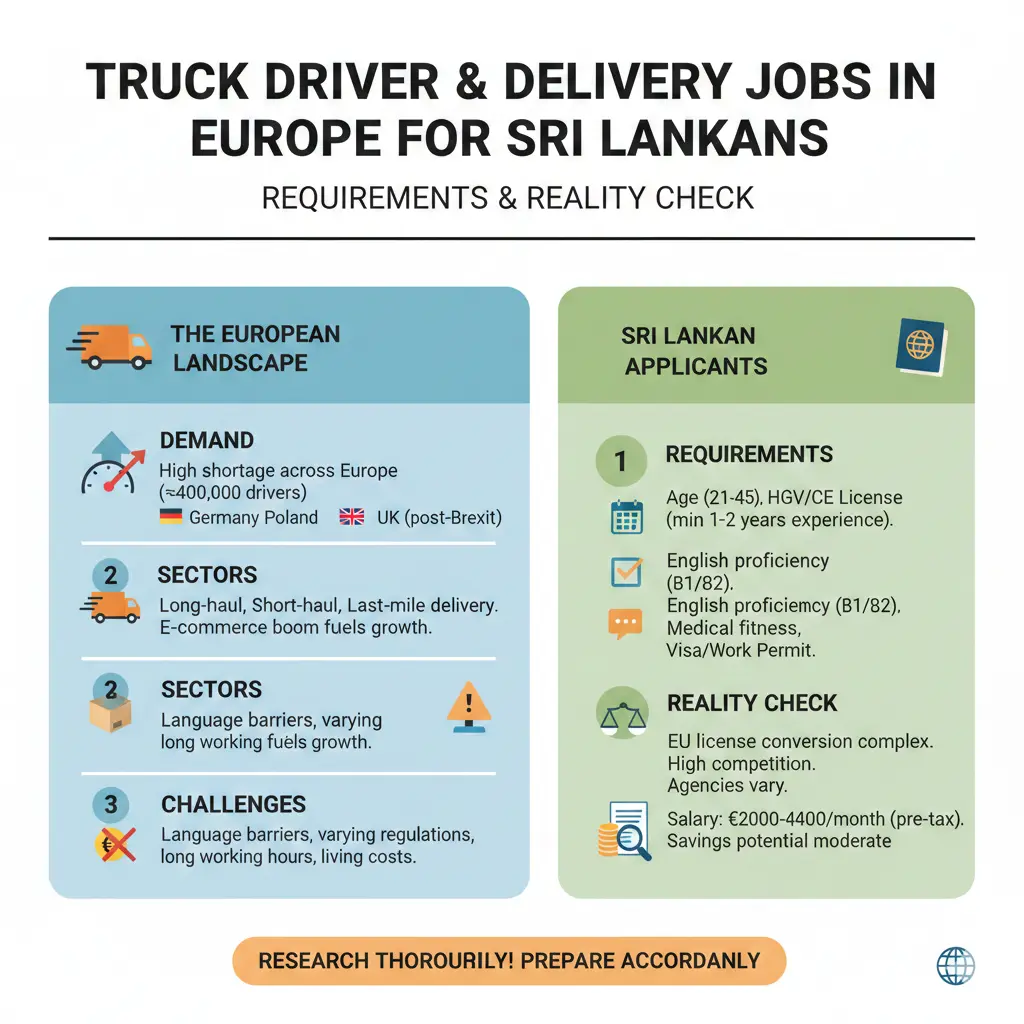
Job Opportunities: What's Actually Available
Yes, there are genuine job opportunities. In early 2026, European logistics companies actively recruited Sri Lankan drivers. For example, Manvesta Logistics advertised 250 lorry driver vacancies specifically targeting Sri Lankan talent, offering salaries ranging from €750 to €2,550 per month plus bonuses.
However, it's crucial to scrutinise job advertisements carefully. The Manvesta Logistics advertisement, whilst offering competitive packages, included some red flags:
- Preference for drivers under 45 years old (which arguably borders on age discrimination)
- Inconsistencies between advertised salaries in euros and their rupee equivalents (sometimes differing by €80-€300)
- Unusual benefit statements, including "food and air ticket not provided"
These details highlight why you should never take job advertisements at face value. Always verify salary conversions independently and clarify what's genuinely included in your employment package.
Essential Requirements for Working as a Professional Driver in Europe
Licensing and Qualifications
To work as a professional driver in Europe, you'll need more than just a valid driving licence. Germany, for example, requires professional drivers from third countries to have:
- An EU or EEA driving licence for the relevant category (HGV/LGV for heavy goods vehicles)
- Initial or accelerated initial qualification under EU Directive 2022/2561
- Proof of these qualifications before employment approval
If you don't already hold an EU or EEA driving licence, you can enter Germany under a fast-track skilled worker programme, but you'll need to obtain both your German driving licence and the required professional qualification within 15 months whilst working.
Salary and Income Requirements
Many European countries have minimum salary thresholds, especially for workers over 45. In Germany in 2026, if you're over 45, you must earn a minimum of €55,770 annually or provide proof of adequate pension provision to work as a professional driver. This is significantly higher than the €750-€2,550 monthly salaries advertised for Sri Lankan drivers, which would equate to €9,000-€30,600 annually.
Language Requirements
Most European countries require at least basic English language skills for professional drivers, particularly for communication at border crossings and with clients. Some positions may require additional language abilities depending on the specific country and employer.
The Schengen Area and Visa Restrictions
One of the biggest challenges facing Sri Lankan truck drivers is the 90-day limit within 180 days imposed by the Schengen Area's Entry-Exit System. This creates a fundamental problem: if you're conducting regular international transport routes across Europe, you'll quickly exceed this threshold and face potential arrest or deportation.
The European Commission is working on solutions, including proposals that would allow drivers to complete their current transport jobs even if they exceed the 90-day limit, but these transitional arrangements aren't yet finalised. Until permanent legislation is enacted, you could face legal complications if you overstay.
The full enforcement of the EES across all EU member states' border crossings is scheduled for 10 April 2026, so regulations are becoming stricter, not more lenient.
Practical Steps for Sri Lankans Considering European Truck Driving Jobs
Before Applying
- Verify the employer's legitimacy: Research the company thoroughly. Check industry websites, contact transport associations, and ask for references from other Sri Lankan drivers they've employed.
- Understand visa requirements: Contact the relevant European embassy in Sri Lanka to understand current visa regulations for your target country. These change frequently.
- Get your qualifications in order: Determine whether your current driving licence and qualifications meet EU standards. You may need to pursue additional certifications before applying.
- Calculate actual costs: Factor in visa fees, relocation costs, accommodation, and the cost of obtaining EU-recognised qualifications. Many job advertisements don't account for these expenses.
- Review salary carefully: Convert advertised salaries using current exchange rates (not the rates listed in the job ad). Account for living costs in the specific European country. A salary that seems generous in rupees may be inadequate in Europe.
During the Application Process
- Request written confirmation of all employment terms, including salary, working hours, accommodation arrangements, and visa sponsorship details
- Ask explicitly about how the employer handles the 90-day Schengen limitation and what happens if you exceed it
- Request contact details of other Sri Lankan drivers currently employed by the company
- Clarify whether the employer will cover visa application costs and processing times
Alternative Opportunities Worth Considering
If European truck driving seems too complicated, consider these alternatives:
- Gulf States employment: Many job advertisements specifically mention preferring drivers with Gulf states experience. Countries like the UAE, Saudi Arabia, and Kuwait often have more straightforward visa processes and higher demand for professional drivers.
- Domestic or regional opportunities: Sri Lanka's logistics sector is growing. Building experience locally first can make you more competitive for international roles later.
- Logistics and warehouse roles: Some European companies hire Sri Lankans for warehouse and logistics positions with pathways to driver training, which may be easier than direct driver recruitment.
Moving Forward: Your Next Steps
If you're seriously considering a truck driving career in Europe, start by:
- Contacting the relevant European embassy in Sri Lanka to understand current visa requirements for your target country
- Researching whether your current qualifications meet EU standards, and what additional certifications you might need
- Joining professional driver networks or forums where Sri Lankan drivers share their experiences
- Carefully evaluating any job offers against the criteria outlined in this article
- Considering whether the Gulf states or domestic opportunities might better suit your immediate needs
The opportunity to work as a professional driver in Europe is real, but it requires careful planning, realistic expectations, and thorough due diligence. Don't let attractive salary figures obscure the genuine complexities and challenges involved. With proper preparation and informed decision-making, you can navigate this path successfully—or determine that alternative opportunities better suit your circumstances.
Frequently Asked Questions
Sources & References
-
1
The EU is working on "a transitional model" for the professional truck drivers from the Western Balkans — europeanwesternbalkans.com
- 2
-
3
Professional drivers from third countries - Make it in Germany — www.make-it-in-germany.com
Related Articles

Long-Distance Marriages: Practical Tips for Sri Lankans Working Overseas
This article references the following sources for accuracy and further reading:

Pathways for Sri Lankan Engineers to Work in Canada, Australia, and the Middle East
This article references the following sources for accuracy and further reading:

Specified Skilled Worker (SSW) Visa for Sri Lankans: Full 2026 Guide
This article references the following sources for accuracy and further reading:

Schooling Abroad: What Sri Lankan Parents Should Know Before Moving with Children
This article references the following sources for accuracy and further reading: