Student Visa to UK Residency Guide
Did you know that 11% of all UK settlers in 2024 first arrived on a student visa, with 61% of them taking about a decade to secure indefinite leave to remain?[2] This challenges the idea that studying abroad is just a temporary adventure—it’s often the first step on a structured path to residency
The Lankawebsites editorial team curates, fact-checks, and updates guides on personal finance, property, health, immigration, legal, business, and lifestyle topics relevant to Lankawebsites readers. Articles are produced with AI assistance and reviewed by the editorial team before publication.
Did you know that 11% of all UK settlers in 2024 first arrived on a student visa, with 61% of them taking about a decade to secure indefinite leave to remain? This challenges the idea that studying abroad is just a temporary adventure—it’s often the first step on a structured path to residency.
You might secure your Tier 4 student visa with grant rates hitting 95% for top nationalities like Indians in Q2 2025, amid 56,000 issuances that quarter alone—a 24% jump from 2024. But success hinges on the Graduate Route visa next, letting you work up to two years post-degree (three for PhDs), followed by Skilled Worker sponsorship. I’ve guided dozens through this, spotting pitfalls like the 9% refusal spike in recent quarters or the 2025 White Paper’s tougher Basic Compliance Assessment thresholds demanding 90% CAS-to-enrolment rates by 2026.
Here, you’ll uncover the exact timelines, eligibility tweaks for dependants, and real strategies—like targeting high-demand fields—to turn your UK degree into permanent residency. Expect nuances: not every course qualifies, and economic shifts can alter sponsor lists overnight.
Understanding the UK Student Visa Route
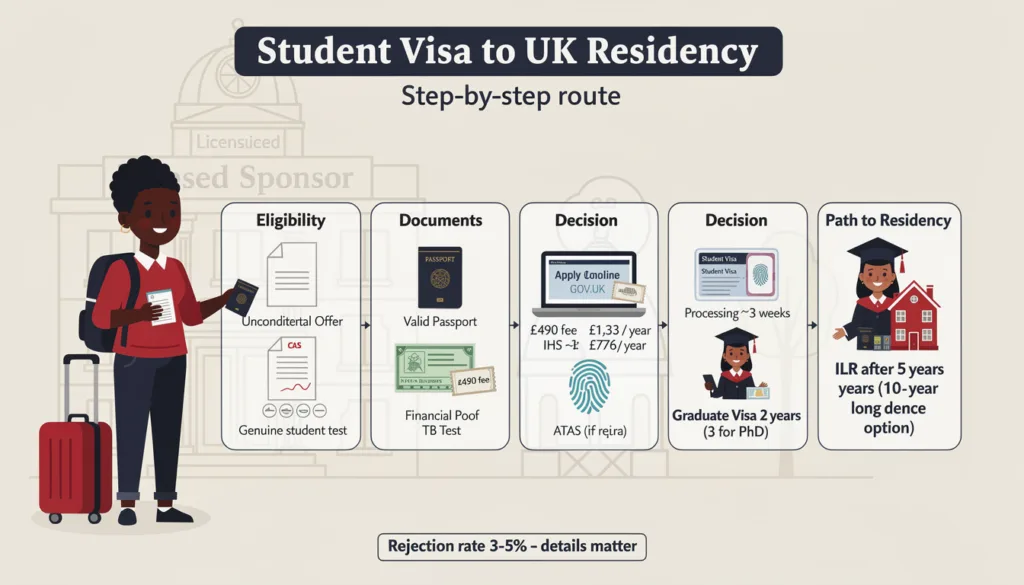
In the year to September 2025, UK authorities granted 419,558 main applicant Student visas, a 7% rise from the prior year despite tighter dependant rules. You secure this visa to study at a licensed sponsor, but treat it as your first step toward potential settlement through post-study work routes.
First, check eligibility. You need an unconditional offer from an approved institution, confirmed by a Confirmation of Acceptance for Studies (CAS). This document lists your course details, fees paid, and start date—agents often miss nuances here, like ensuring the CAS matches your passport exactly. Genuine students qualify if they prove intent to study, not work. Exceptions apply: government-sponsored students skip some proofs, and Child Student visas differ for under-18s.
Gather documents carefully. Submit a valid passport valid for your stay. Most nationalities require a tuberculosis (TB) test from approved clinics—say, from India, get it within six months. Prove finances: £1,334 monthly (up to nine months) outside London, or £1,023 inside, via bank statements no older than 28 days. ATAS certificate mandates for sensitive subjects like nuclear physics. I’ve seen applications bounce back for minor TB expiry slips; always double-check.
Post-Brexit, you apply online via GOV.UK, pay the fee—£490 for courses over six months—and £776 Immigration Health Surcharge yearly. Biometrics follow at a visa centre. Processing takes three weeks from outside the UK, faster with priority (£500 extra). Visa duration matches your course plus wrap-up time: four months post-graduation for degree levels.
Consider Aisha, a Nigerian master’s student. She matched her CAS finances precisely, passed her TB test in Lagos, and landed her visa in 18 days. Yet, time on this visa rarely counts toward the five-year Indefinite Leave to Remain (ILR) clock—except the 10-year long residence path needing unbroken lawful stay. Plan ahead: Graduate visa next offers two years (three for PhDs) job-free work.
Success hinges on details. Rejection rates hover at 3-5%, so align everything meticulously. You control your path from university to residency.

Transitioning to Graduate Visa After Studies

In 2024 alone, the UK granted 238,000 Graduate visas to international students and their dependants, underscoring how this route has exploded in popularity since its 2021 launch.
Here’s the part most people miss. You finish your degree, but your Student visa clock is ticking down fast. Apply for the Graduate visa before that expires—usually within your final term—to snag up to 2 years (bachelor’s or master’s) or 3 years (PhD) to hunt jobs or work freely, no sponsorship needed, no minimum salary, any role allowed. I remember advising a computer science master’s grad from Nigeria in 2022; she switched seamlessly two weeks before her Student visa lapsed, landing a data analyst role at a London fintech firm six months later without sponsor hassles.
This visa buys you breathing room. Use it to network at career fairs, polish your CV for UK standards, or even freelance—self-employment counts fully. Picture Raj, an engineering PhD from India: his extra year let him publish research, collaborate on projects, and pivot to a sponsored Skilled Worker visa in renewable energy, sidestepping the care sector trap where 40% of direct study-to-Skilled Worker switchers ended up in 2024, often overqualified. Time on Student or Graduate visas doesn’t count toward the 5 years of sponsored work needed for Indefinite Leave to Remain (ILR), except under the rare 10-year long residence path requiring unbroken lawful stay.
Act now, though. From 1 January 2027, non-PhD stays drop to 18 months for new applicants, squeezing your job hunt window as part of immigration reforms pushing quicker Skilled Worker transitions. Apply by 31 December 2026 for the full 2 years. Exceptions apply: confirm your course counts via your university’s confirmation of completion, and dependants qualify too if eligible.
Plan your switch like a pro. Track Home Office processing times (often 8 weeks online), budget £822 for the main applicant plus Immigration Health Surcharge, and line up interviews early. Many overlook ATAS clearance for STEM fields, delaying apps. Get this right, and you bridge straight to Skilled Worker sponsorship—your settlement runway.
Securing a Skilled Worker Visa
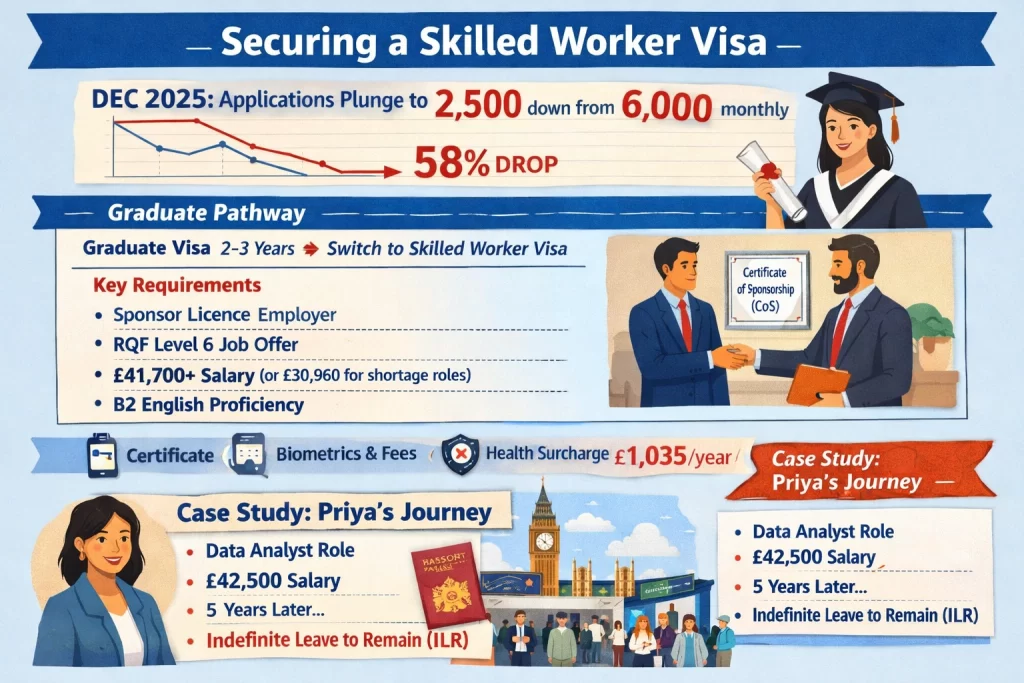
In December 2025 alone, Skilled Worker visa applications dropped to just 2,500 main applicants, down from stable levels around 6,000 monthly pre-2025 policy shifts—a 58% plunge reflecting tighter rules on skills and salaries. But here’s where it gets interesting. You finish your degree, snag a Graduate visa for two years (three for PhDs) to job-hunt freely, then pivot to a Skilled Worker visa—the direct highway from campus to permanent residency after five years of sponsored work.
Your employer needs a valid sponsor licence first, issued by the Home Office after they prove compliance with UKVI checks like right-to-work verification and record-keeping. They offer you a job at RQF Level 6 or above—think graduate-level roles like software developer or marketing analyst—unless it’s on the Immigration Salary List or Temporary Shortage List, where RQF3+ still qualifies with exceptions. Secure that Certificate of Sponsorship (CoS), and you apply to switch in-country from your Graduate visa.
Salary hits £41,700 minimum as of 2026, steady from 2025 hikes, though Immigration Salary List roles dip lower—say, £30,960 for select shortages. Prove B2 English proficiency starting January 8, 2026, via IELTS 5.5+ or equivalent; no more B1 leniency. You meet these? Submit biometrics, pay the £719 fee (plus £1,035 health surcharge yearly), and get five years’ leave. Time on Student visa doesn’t count toward ILR’s five-year clock—only Skilled Worker tenure does, barring the 10-year long residence path.
Take Priya, a computer science master’s grad I advised last year. She landed a data analyst role (RQF6) at £42,500 with a licensed tech firm during her Graduate visa window. Switched seamlessly, hit ILR after five years. Watch nuances: new entrants under 26 or recent PhD grads get salary discounts to 70% of going rates. Care roles? No overseas recruitment since 2025, but in-country switches linger till 2028.
Employers, audit your licence yearly—lapses kill sponsorships. You? Network via university career fairs; 15,700 Skilled Worker apps May-August 2025 show demand persists despite drops. Nail this switch, and settlement awaits.
From ILR to British Citizenship

Of the two million migrants eligible for Indefinite Leave to Remain (ILR) from the 2021-2024 visa cohort, around 686,000 could secure it between January 2026 and June 2029, setting them up for citizenship just one year later. You secure ILR after five years on a Skilled Worker visa—post your Graduate visa stint following university. Time on your Student visa doesn’t count toward that five-year clock, except if you aim for the 10-year long residence route.
Picture this: Priya graduates with a master’s from Manchester University in 2024, switches to a two-year Graduate visa, then lands a sponsored data analyst role on Skilled Worker. By 2029, she applies for ILR, proving continuous residence, a steady salary above the threshold (currently £38,700, rising with inflation), and B1 English level via approved tests like IELTS. Home Office data shows 64,470 work-route settlements in the year to March 2025, with Skilled Worker grants hitting 49,493—a 54% jump. Priya’s path matches this surge.
Once you hold ILR, wait one year of continuous residence. Then apply for naturalisation. Pass the Life in the UK test (18 multiple-choice questions on history, values, daily life—book it online for £50). Submit Form AN, pay £1,580 fee, and attend a ceremony within three months to swear allegiance. Exceptions apply: if married to a British citizen, skip the one-year wait, but prove two years’ residence total. Absences over 450 days in the qualifying period or 90 days in the final year disqualify you—track them meticulously with passport stamps and P60s.
British citizenship unlocks full benefits. Access NHS healthcare without surcharge. Vote in all elections. Hold a UK passport—ranked sixth globally for visa-free travel, letting you jet to 190 countries hassle-free. No more visa renewals. Sponsor family easier.
Not ready for the five-year Sponsored Worker track? Build 10 continuous years of lawful residence across visas, including Student time. University of Oxford staff immigration notes this route demands no gaps in leave, plus good character and English. In 2025, Family Life (10-year) grants tripled to 2,535, showing its viability for blended paths. Watch proposed reforms: government eyes extending most ILR routes to 10 years, with “contributions” like high salaries potentially shortening it. Plan ahead—use the points-based calculator on GOV.UK to check eligibility yearly.
Your university start can end in citizenship. Stay sponsored, reside steadily, test rigorously.
Frequently Asked Questions
Sources & References
-
1
GOV.UK — www.gov.uk
-
2
UKCISA — www.ukcisa.org.uk
-
3
British Council Study UK — study-uk.britishcouncil.org
-
4
University of Oxford Staff Immigration — staffimmigration.admin.ox.ac.uk
-
5
[BHE UNI] — bheuni.io
-
6
[BHE UNI] — bheuni.io
-
7
[Sable International] — www.sableinternational.com
-
8
[British Council Study UK] — study-uk.britishcouncil.org
-
9
[University of Oxford Staff Immigration] — staffimmigration.admin.ox.ac.uk
-
10
[BHE UNI] — bheuni.io
-
11
[Sable International] — www.sableinternational.com
-
12
[University of Oxford Staff Immigration] — staffimmigration.admin.ox.ac.uk
Related Articles

Quebec: The "French" Wall and the Cultural Goldmine
Imagine stepping off a plane into a city where the air smells of fresh croissants and poutine, where historic architecture meets modern vibrancy, and where the cost of living lets you enjoy life's ple

Australia - Schedule 3 Issues: Protecting Your Visa Status While Building Relationships
In the world of Australian immigration, "Schedule 3" is a term that strikes fear into the hearts of onshore applicants. For many Sri Lankans who travel to Australia on a student or visitor visa and subsequently fall in love with an Australian citizen or permanent resident, the transition to a Partn
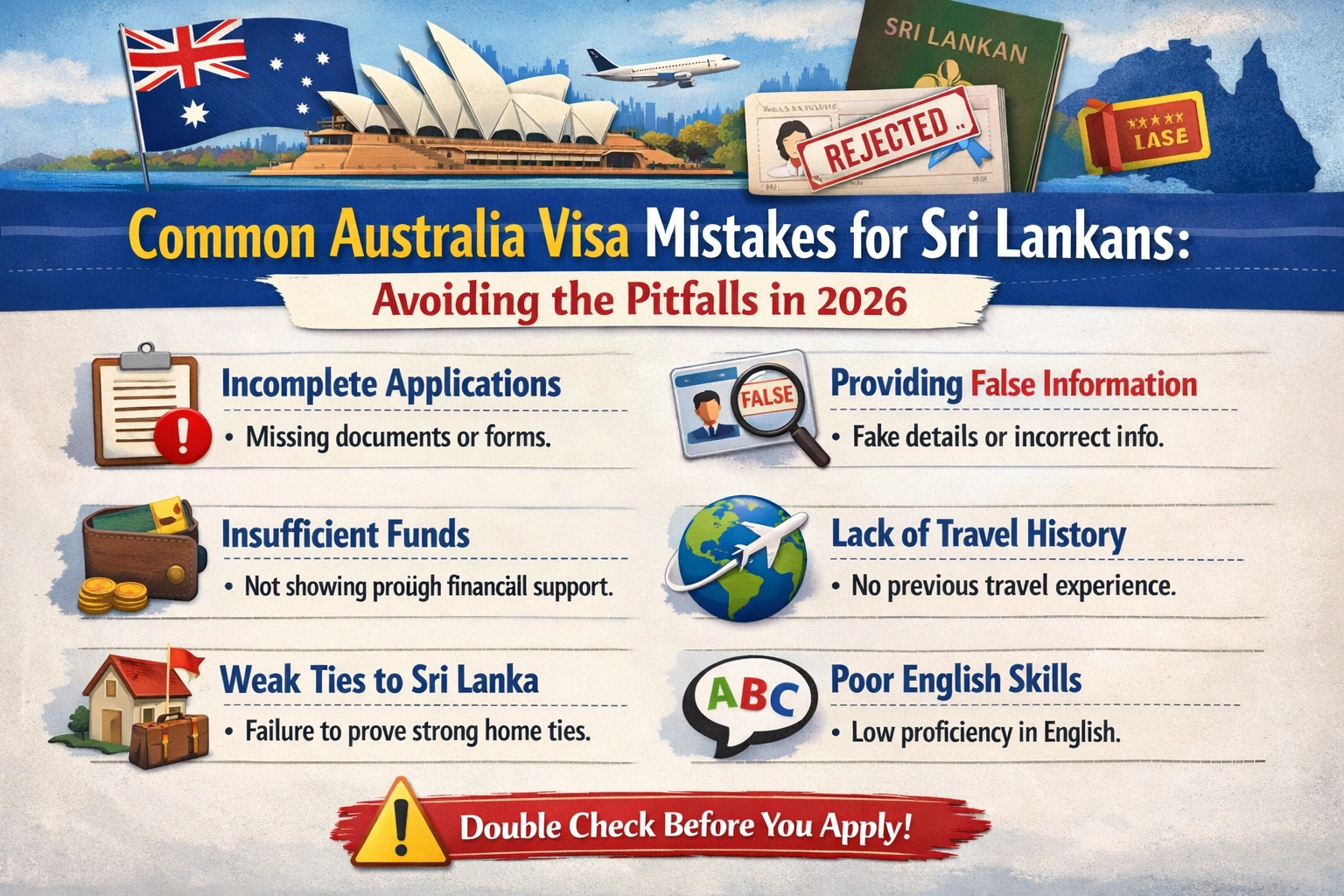
Common Australia Visa Mistakes for Sri Lankans: Avoiding the Pitfalls in 2026
The journey from Sri Lanka to Australia is paved with good intentions but often derailed by small, avoidable errors. In 2026, the Australian Department of Home Affairs (DoHA) has moved toward a "zero-tolerance" digital verification system. A single inconsistency in your employment dates or a "parke

Australia Credential Recognition: Getting Your Sri Lankan Qualifications Assessed
One of the biggest hurdles for Sri Lankan professionals moving to Australia is "Credential Recognition." You may be a senior engineer in Colombo or a lead developer in Kandy, but to the Australian Department of Home Affairs, your skills don't exist until they are "validated" by an Australian assess