Sri Lanka GDP Growth Forecast 2026: World Bank vs Local Projections Analysis
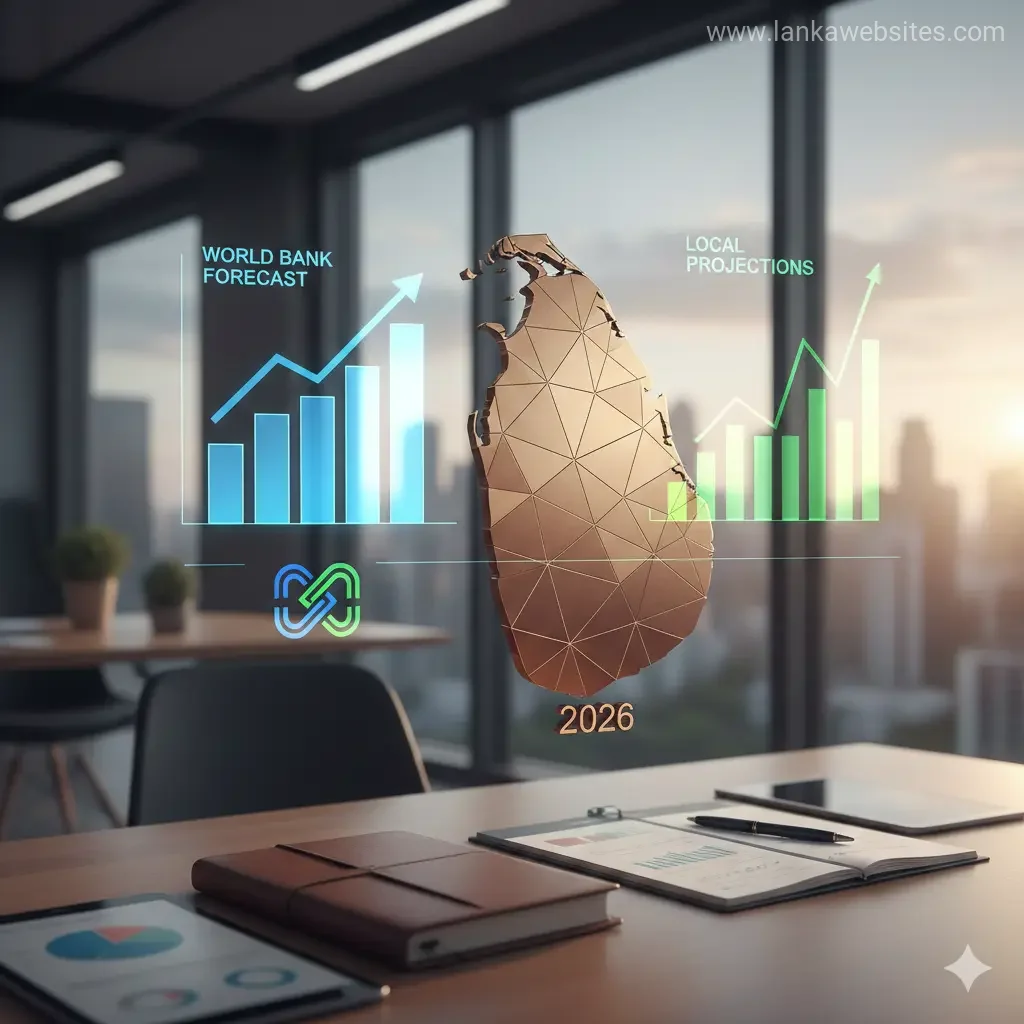
Sri Lanka's economic growth forecast for 2026 presents a striking divergence between international institutions and local authorities, with projections ranging from 3.5% to 5%. This gap reflects diffe
The Lankawebsites editorial team curates, fact-checks, and updates guides on personal finance, property, health, immigration, legal, business, and lifestyle topics relevant to Lankawebsites readers. Articles are produced with AI assistance and reviewed by the editorial team before publication.
Sri Lanka's economic growth forecast for 2026 presents a striking divergence between international institutions and local authorities, with projections ranging from 3.5% to 5%. This gap reflects differing assessments of how quickly the country can sustain its recovery following the severe economic crisis of 2022-2023. Understanding these competing forecasts is crucial for businesses, investors, and policymakers navigating the year ahead.
The Central Bank's Optimistic Outlook
The Central Bank of Sri Lanka (CBSL) has projected economic growth of 4-5% for 2026, a notably optimistic assessment compared to international forecasters. Central Bank Governor Namdalal Weerasinghe announced this projection in January 2026, positioning it as higher than predictions from both the IMF and World Bank.
The CBSL's confidence is anchored in three main drivers:
- Reconstruction activity following Cyclone Ditwah's impact in late 2025
- Increased consumer spending as economic confidence rebuilds
- Stronger consumption-driven credit demand supporting business activity
According to the Central Bank's Monetary Policy Report 2026, the near-term growth outlook remains moderate, though subject to considerable uncertainty from volatile global geopolitical conditions. The report notes that real GDP growth moderated in Q4 2025 due to cyclone-related disruptions, but recovery momentum is expected to continue into 2026.
International Institutions Paint a More Cautious Picture
World Bank's Conservative Forecast
The World Bank's Global Economic Prospects report (January 2026) forecasts Sri Lanka's growth will decelerate to 3.5% in 2026. This projection reflects structural challenges that persist despite recent recovery efforts, including factor and product market inefficiencies, lingering scarring effects from the 2022-2023 crisis, and global economic uncertainty dampening export demand.
Asian Development Bank's Middle Ground
The Asian Development Bank (ADB) takes a position between these extremes, forecasting 3.4% growth for 2026. The ADB's April 2025 outlook acknowledges that recovery has exceeded expectations but warns it remains fragile. The bank emphasises that while investor confidence should improve as election uncertainties and debt restructuring fade, consumer demand will likely remain sluggish amid rising inflation.
Private Sector Analysis
Fitch Solutions has revised its 2026 forecast upward to 3.2%, suggesting a slightly more optimistic view than the World Bank but still well below the CBSL's projection.
Why the Forecasts Diverge
Different Risk Assessments
International institutions emphasise downside risks that could constrain growth:
- Trade uncertainty, including U.S. tariff policies affecting Sri Lankan exports
- Loss of reform momentum in structural economic policies
- Macroeconomic policy slippages
- Persistent debt vulnerability (public debt-to-GDP ratio projected above 95% until 2032)
The CBSL, conversely, appears to weight the positive momentum from reconstruction spending and credit expansion more heavily in its calculations.
Cyclone Ditwah's Lingering Impact
The cyclone that struck Sri Lanka in late 2025 created divergent forecasting scenarios. Whilst the government implemented relief measures and supplementary budgets for infrastructure restoration, the CBSL views this as a catalyst for reconstruction-led growth, whilst international institutions see it as a temporary drag on an already fragile recovery.
Credit Growth and Consumer Spending
The CBSL projects that consumption-driven credit demand will strengthen economic activity significantly. However, the ADB warns that consumer demand will remain sluggish due to expected rising inflation, suggesting households may prioritise debt repayment over new spending.
What These Forecasts Mean for You
For Businesses
If growth reaches the CBSL's projected 4-5%, businesses can expect stronger domestic demand and improved credit availability for expansion. However, the more conservative international forecasts suggest you should plan for tighter consumer spending and potentially slower market growth. Diversifying export markets becomes critical given global trade uncertainties.
For Investors
The divergence creates both opportunity and risk. Domestic equity markets may benefit from the CBSL's optimistic outlook, but international investors should consider the World Bank's caution about structural impediments. Inflation management remains crucial—the Central Bank is expected to cut rates by 25 basis points to 7.50% by end-2026, potentially improving returns on fixed-income investments.
For Job Seekers and Workers
Growth in the 3.5-5% range typically supports employment creation, though the pace depends on which forecast proves more accurate. Sectors like construction and tourism—key drivers in both scenarios—should see stronger hiring. However, inflation pressures may limit real wage growth even as nominal employment expands.
Key Economic Indicators to Watch
Several factors will determine which forecast proves more accurate:
- Inflation trends: Rising prices could dampen consumer spending below the CBSL's expectations
- Credit growth: Private sector credit expansion is essential to the CBSL's scenario
- Export performance: Trade policy developments will significantly impact growth
- Foreign exchange reserves: Continued build-up supports macroeconomic stability
- Tourism and remittances: These sectors have remained resilient and will be crucial to 2026 growth
Frequently Asked Questions
Q: Which forecast should I trust more—the Central Bank or the World Bank?
Both have merit. The CBSL has better real-time data on domestic conditions and credit flows, making its 4-5% projection credible for optimistic scenarios. However, international institutions bring external perspective and track record of caution that's often warranted. The truth likely lies between 3.5-4.5%, depending on how successfully Sri Lanka manages inflation and maintains reform momentum.
Q: How does the 2026 forecast compare to 2025 performance?
Sri Lanka achieved approximately 5% growth in the first nine months of 2025 before cyclone-related disruptions in Q4. The 2026 forecasts of 3.4-5% represent either a continuation (at the CBSL's upper range) or a modest slowdown (at the World Bank's estimate) from 2025's performance.
Q: Will rising inflation affect my purchasing power in 2026?
The ADB specifically warns that inflation is expected to rise in 2026 even as growth moderates. This means real (inflation-adjusted) income growth could be significantly lower than nominal growth figures suggest. Wage negotiations and investment returns should account for this inflation risk.
Q: How do global trade tensions affect Sri Lanka's 2026 growth?
Trade uncertainty is cited as a significant downside risk by international institutions. U.S. tariff policies and geopolitical tensions could reduce demand for Sri Lankan exports and limit growth to the lower end of forecasts. However, Sri Lanka's tourism sector and remittance inflows have shown resilience, providing some buffer.
Q: Is Sri Lanka's debt situation improving or worsening?
The debt situation is slowly improving but remains a structural constraint. The public debt-to-GDP ratio is projected to fall below 95% only by 2032, meaning high debt will continue limiting policy flexibility throughout 2026. The ADB emphasises the need to sustain reform efforts to avoid debt distress.
Q: What sectors are likely to grow fastest in 2026?
Construction (reconstruction-related), tourism, and financial services (credit expansion) are positioned for strongest growth across all forecasts. Agriculture faces headwinds from climate uncertainty, whilst manufacturing depends heavily on export demand amid trade tensions.
What This Means for Your Planning
The 2026 growth forecasts, ranging from 3.5% to 5%, suggest the Sri Lankan economy will continue recovering but at a measured pace. The divergence between local and international projections reflects genuine uncertainty about how quickly structural reforms will take hold and whether external shocks will derail progress.
For practical purposes, plan conservatively around 3.5-4% growth unless you have sector-specific reasons to expect better performance. Monitor inflation developments closely, as rising prices could squeeze real incomes even as nominal growth figures look respectable. If you're investing or expanding a business, diversify across sectors and geographies to hedge against forecast misses.
The Central Bank's optimism about reconstruction-led growth has merit, particularly if you're in construction, hospitality, or related sectors. However, the international institutions' caution about consumer demand and structural impediments deserves respect, especially if you depend on domestic consumer spending or face export competition.
Keep watching official Central Bank policy decisions and quarterly GDP releases—they'll clarify which forecast trajectory Sri Lanka is actually following. The gap between 3.5% and 5% represents meaningful economic difference, so staying informed helps you make better decisions for your business, career, and investments.
Related Articles

Infrastructure Spending: How Reconstruction Fuels Sri Lanka's 2026 Recovery
Imagine driving along the Colombo-Kandy highway, smooth and expanded, or watching a new bridge span the Kelani River, easing traffic for thousands of daily commuters. That's the promise of Sri Lanka's

Corporate Earnings Growth in Sri Lanka 2026: 15-20% Forecast Breakdown
Imagine watching the Colombo Stock Exchange's All Share Price Index (ASPI) climb steadily in 2026, driven by solid corporate profits even as the broader economy navigates headwinds. For us in Sri Lank

Step-by-Step Guide: Accessing Government Reconstruction Contracts in Sri Lanka 2026
Imagine turning the devastation from Cyclone Ditwah into your business's biggest opportunity. With Sri Lanka's economy set to grow over 5% in 2026 thanks to massive reconstruction efforts, SMEs across

Sri Lanka Credit Growth Opportunities: How Businesses Can Leverage 2026 Expansion
Sri Lanka's economy is heating up with private credit hitting a record Rs262 billion in November 2025, signalling strong **Sri Lanka credit growth** that's set to fuel business expansion in 2026.[1] F