Fitch vs CBSL Growth Forecasts 2026: What Sri Lankan CEOs Need to Know
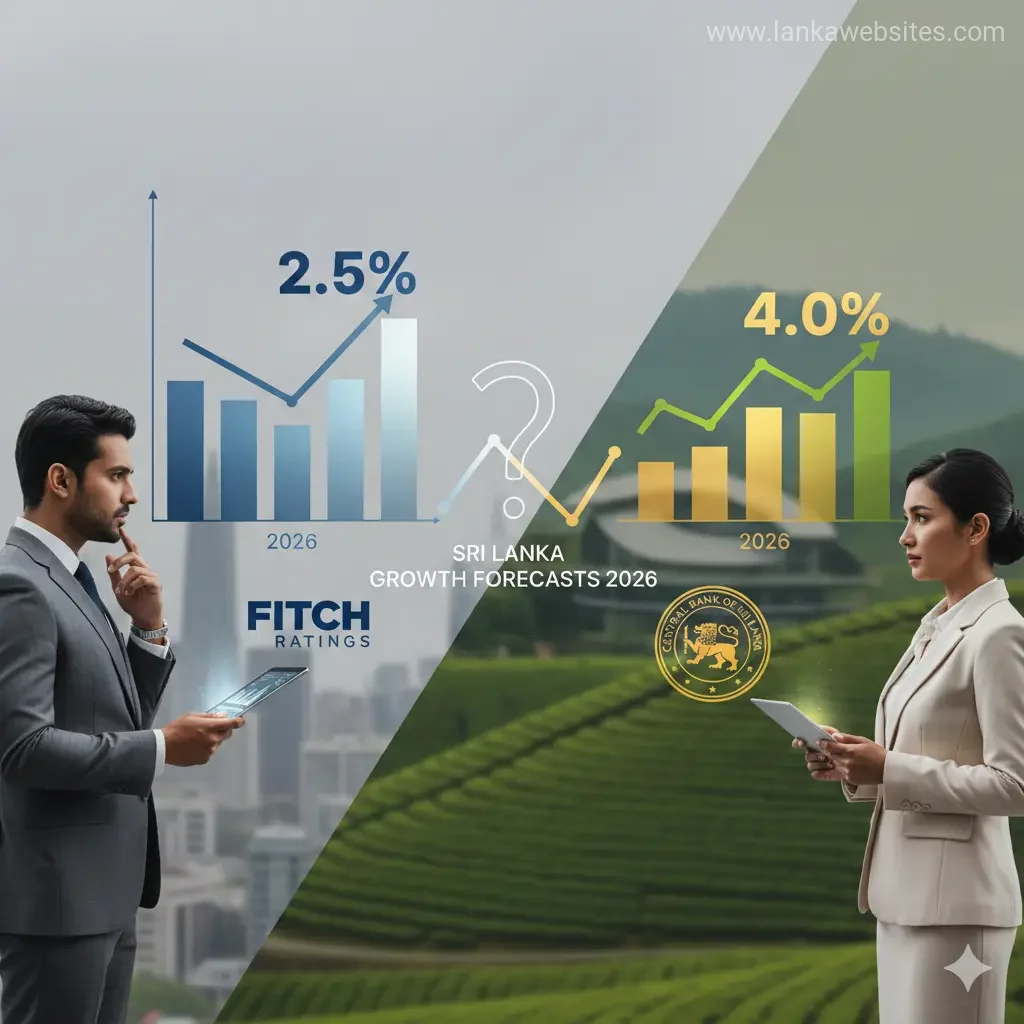
Sri Lanka's economic outlook for 2026 is shaping up to be a critical year for business planning, but there's a notable divergence between what the Central Bank of Sri Lanka (CBSL) is projecting and wh
The Lankawebsites editorial team curates, fact-checks, and updates guides on personal finance, property, health, immigration, legal, business, and lifestyle topics relevant to Lankawebsites readers. Articles are produced with AI assistance and reviewed by the editorial team before publication.
Sri Lanka's economic outlook for 2026 is shaping up to be a critical year for business planning, but there's a notable divergence between what the Central Bank of Sri Lanka (CBSL) is projecting and what international forecasters like Fitch are predicting. For CEOs and business leaders, understanding these different forecasts isn't just academic—it directly impacts investment decisions, hiring plans, and strategic positioning. Let's break down what's driving these competing predictions and what they mean for your business.
The Growth Forecast Gap: CBSL vs Fitch
The Central Bank of Sri Lanka has projected that real GDP growth will reach 4–5% in 2026. This optimistic forecast was announced by Central Bank Governor Namdalal Weerasinghe and is based on expectations that reconstruction activities following Cyclone Ditwah, consumption-driven credit growth, and continued economic momentum will support expansion.
In stark contrast, Fitch Solutions has revised their 2026 growth forecast to just 3.2%. The World Bank's projection sits somewhere in between, forecasting growth of 3.5% for Sri Lanka in 2026.
This means we're looking at a potential range of 3.2% to 5%—a gap that's significant when you're planning capital expenditure, workforce expansion, or market entry strategies. A company banking on 5% growth will face very different challenges if the economy only grows at 3.2%.
Why the Central Bank is More Optimistic
The CBSL's higher forecast rests on several concrete factors that are worth examining:
Reconstruction and Government Spending
Following Cyclone Ditwah's impact in late 2025, the government implemented relief measures and supplementary budgets to restore affected infrastructure. This reconstruction spending is expected to provide a near-term boost to economic activity. For businesses in construction, materials supply, and related services, this creates real opportunities.
Consumer Spending and Credit Growth
The CBSL expects consumption-driven credit demand to strengthen economic activity. This reflects confidence that households and businesses will access credit for spending and investment as monetary conditions remain accommodative. The Central Bank has been gradually easing its policy rate, signalling support for credit expansion.
Continued Economic Momentum
Sri Lanka's economy showed resilience in 2024 (5% growth) and 2025, with expansion across industry, tourism, and services. The CBSL believes this momentum will continue into 2026, particularly as structural reforms take root.
Why Fitch and the World Bank are More Cautious
The more conservative forecasts from Fitch and the World Bank reflect genuine risks that CEOs should factor into their planning:
Global Geopolitical Uncertainty
The CBSL itself acknowledged that global geopolitical tensions and trade uncertainties pose considerable risks to the growth outlook. Fitch's lower forecast likely reflects concerns about how trade tensions could impact Sri Lanka's export-dependent sectors like apparel, tea, and tourism.
Regional Growth Slowdown
The World Bank notes that excluding India and Bangladesh, regional growth in South Asia is expected to slow to 3.6% in 2026. Since Sri Lanka's growth depends partly on demand from neighbouring economies and the broader region, this regional slowdown could drag on our growth prospects.
Structural Challenges
While the economy has stabilised after the 2022 crisis, structural challenges remain—including the need to boost exports, attract foreign investment, and ensure inclusive recovery. These aren't quick fixes, and they constrain how fast the economy can realistically grow.
What This Means for Your Business Planning
So how should you navigate this uncertainty? Here are practical considerations:
Build Scenarios, Not Single Forecasts
Rather than betting on one number, develop business plans for a range of outcomes. Model your operations under 3.2% growth (Fitch scenario), 3.5% growth (World Bank scenario), and 4.5% growth (CBSL midpoint). This helps you identify which strategies are robust across different outcomes and where you're most exposed to growth assumptions.
Watch the Credit Cycle
The CBSL's optimism hinges partly on consumption-driven credit growth. If credit growth accelerates faster than expected, the CBSL's forecast becomes more likely. Conversely, if households and businesses remain cautious about borrowing, growth could track closer to Fitch's projection. Monitor credit growth data monthly—it's a leading indicator of where the economy is actually heading.
Track Reconstruction Spending
The government's supplementary budgets for Cyclone Ditwah recovery are real money flowing into the economy. If you're in construction, logistics, or supply chain management, this represents genuine demand. Track government procurement announcements and project timelines to capture these opportunities.
Assess Your Export Exposure
Global trade tensions are a key risk factor that Fitch is pricing in. If your business is export-dependent, stress-test your revenue projections under scenarios where global demand softens. Conversely, if you're primarily domestic-focused, you're less exposed to this particular risk.
The Role of Monetary Policy
The Central Bank is expected to cut interest rates by 25 basis points to 7.50% by the end of 2026, with further easing constrained by inflation concerns and the need to support the rupee. This matters because lower rates make borrowing cheaper for businesses and consumers, supporting the CBSL's growth scenario. However, if inflation picks up or the rupee comes under pressure, the CBSL may hold rates steady, which would weigh on growth.
Key Sectors to Watch
Different sectors will perform differently under various growth scenarios:
- Tourism and Hospitality: Highly sensitive to global economic conditions. Fitch's caution about geopolitical uncertainty could impact this sector more than others.
- Construction and Materials: Will benefit most from reconstruction spending and higher growth. Likely to perform well even under the Fitch scenario if government spending continues.
- Apparel and Exports: Vulnerable to trade tensions. Monitor global trade policy developments closely.
- Financial Services: Will benefit from credit growth and lower interest rates. The CBSL's optimism about credit expansion is good news for banks and fintech firms.
- Retail and Consumer Goods: Will track consumption growth. The difference between 3.2% and 4.5% growth translates into meaningful differences in consumer spending patterns.
Frequently Asked Questions
Which forecast should I trust more—CBSL or Fitch?
Both have merit. The CBSL has better access to real-time economic data and understands local conditions intimately. Fitch brings international perspective and has no domestic political incentives. Rather than choosing one, use both as bookends for your planning. The CBSL forecast represents an optimistic scenario; Fitch represents a more cautious one. Reality will likely fall somewhere in between.
How much will interest rates fall in 2026?
The Central Bank is expected to cut rates by approximately 25 basis points to 7.50% by end-2026, though this depends on inflation and currency stability. However, further cuts may be limited if inflation rises or the rupee weakens.
Will Cyclone Ditwah recovery actually boost growth as much as the CBSL suggests?
Government reconstruction spending will provide a real boost, but the net effect depends on how quickly projects are implemented and whether the spending is additional (new money) or redirected from other areas. Monitor government budget execution reports to gauge actual spending flows.
What's the biggest risk to the CBSL's optimistic forecast?
Global geopolitical tensions and trade policy uncertainty. If major trading partners implement protectionist measures or if geopolitical conflicts disrupt supply chains, export-dependent sectors will suffer, pulling down overall growth.
Should I expand my workforce based on these forecasts?
Proceed cautiously. If your business is sensitive to growth assumptions (e.g., discretionary consumer goods), wait for clearer signals before committing to permanent headcount increases. Consider flexible staffing arrangements (contractors, temporary workers) that can scale with actual demand.
How do these forecasts compare to historical growth rates?
Sri Lanka grew 5% in 2024 and maintained momentum through 2025. The 3.2–5% range for 2026 represents a slight moderation from recent performance, reflecting both the impact of Cyclone Ditwah and normalisation after the post-crisis rebound. This is still respectable growth, but not the accelerating trajectory some might have hoped for.
Moving Forward: Your Action Plan
The divergence between CBSL and Fitch forecasts isn't a problem to solve—it's a planning tool to use. Here's what you should do:
- Develop three-scenario financial models: Build projections for 3.2%, 3.8%, and 4.5% growth. Identify which strategies work across all scenarios and which are sensitive to growth assumptions.
- Monitor leading indicators monthly: Watch credit growth, government spending execution, export orders, and exchange rate movements. These will tell you which forecast is tracking more accurately as the year unfolds.
- Stay flexible: Structure investments and commitments so you can adjust course if actual growth diverges sharply from expectations. Avoid irreversible bets on any single forecast.
- Engage with sector peers: Compare notes with other businesses in your sector. Collective intelligence often reveals patterns that individual companies miss.
- Review quarterly: Don't set your strategy in January and ignore it until December. Quarterly reviews of actual vs. forecast growth will help you recalibrate your assumptions.
The good news is that even under Fitch's more conservative 3.2% forecast, Sri Lanka's economy will be growing. The challenge is managing the uncertainty around how much growth we'll actually see. By building scenario-based plans and staying alert to leading indicators, you'll be better positioned than competitors who assume a single outcome. In a volatile environment, flexibility and adaptability are competitive advantages.
Related Articles

Starting a Private Limited Company in Sri Lanka 2026: Step-by-Step Guide
Thinking about turning your business idea into a reality in Sri Lanka? Registering a **private limited company** gives you limited liability protection, credibility with banks and partners, and a soli

IMF Debt Targets for Sri Lanka: How Corporations Can Navigate 95% GDP Reduction by 2032
Sri Lanka's path to economic recovery hinges on meeting tough IMF debt targets, including slashing public debt to 95% of GDP by 2032. For corporations, this means rethinking debt strategies amid tight

KPMG Budget 2026 Insights: Key Impacts on Sri Lankan Corporate Reserves
As corporate leaders in Sri Lanka navigate the uncertainties of 2026, KPMG's sharp analysis of the Budget reveals critical shifts that could reshape how we manage our reserves. With foreign reserves h

Agriculture-to-Corporate Supply Chains: Leveraging 3.6% Sector Growth in 2026
Sri Lanka's agricultural sector is experiencing a pivotal moment in 2026. With steady growth momentum and an increasingly modernised supply chain, businesses and entrepreneurs across the island have u