Central Bank of Sri Lanka Policy Agenda 2026: What Businesses Need to Know
As business owners in Sri Lanka, we're all feeling the effects of the post-crisis recovery, from fluctuating interest rates to supply chain hiccups like those from Cyclone Ditwah. The Central Bank of
The Lankawebsites editorial team curates, fact-checks, and updates guides on personal finance, property, health, immigration, legal, business, and lifestyle topics relevant to Lankawebsites readers. Articles are produced with AI assistance and reviewed by the editorial team before publication.
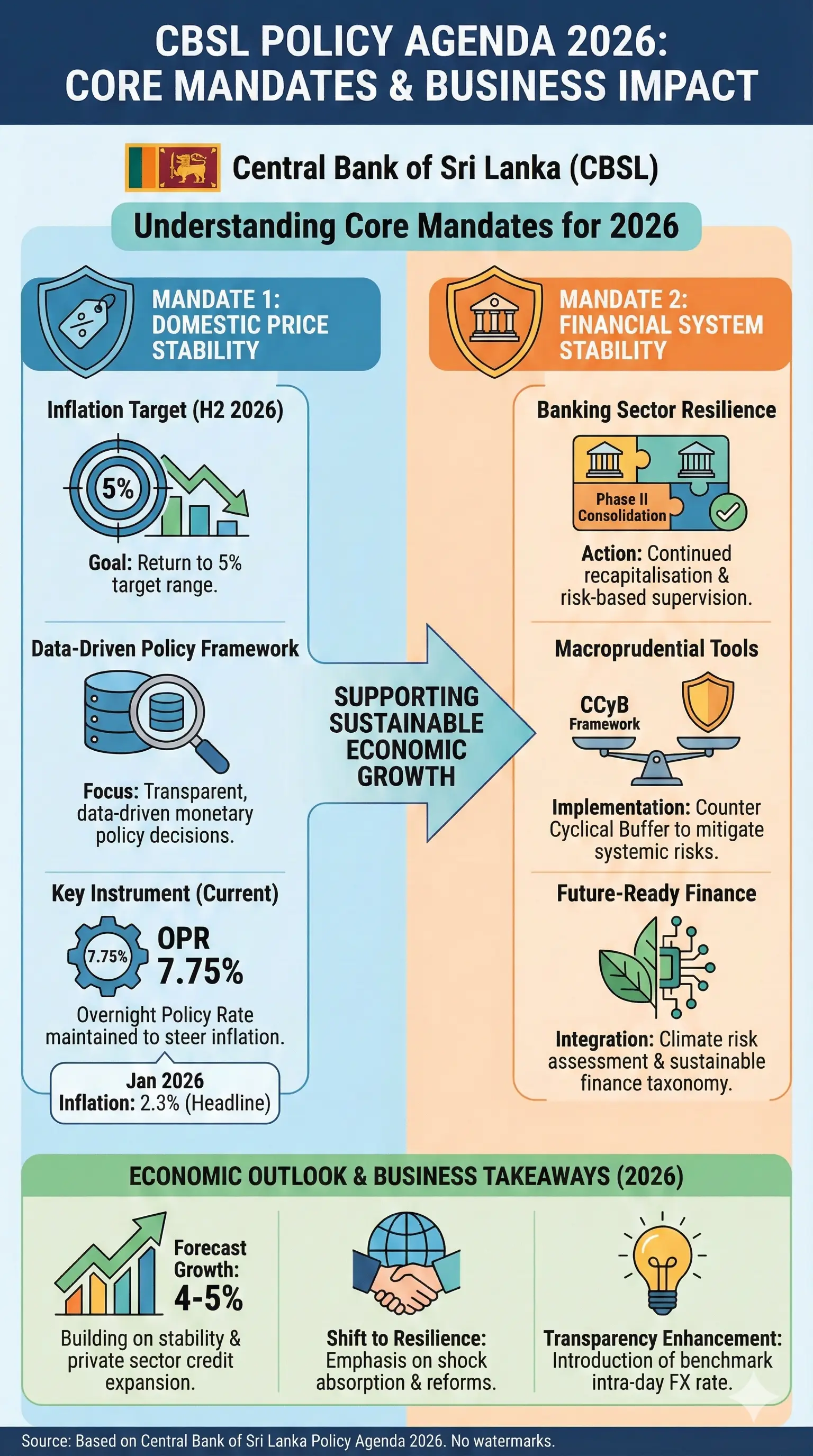
As business owners in Sri Lanka, we're all feeling the effects of the post-crisis recovery, from fluctuating interest rates to supply chain hiccups like those from Cyclone Ditwah. The Central Bank of Sri Lanka's (CBSL) Policy Agenda for 2026 and Beyond lays out a clear roadmap to keep our economy steady at 4-5% growth while targeting 5% inflation—news that's crucial for planning your next investment or loan. Here's what you need to know to stay ahead.
Understanding CBSL's Core Mandates for 2026
The CBSL's agenda focuses on three pillars: price stability, financial system stability, and economic growth support. Released on 8 January 2026, it builds on 2025's easing of monetary policy to foster recovery. With the Overnight Policy Rate (OPR) held steady at 7.75% as of January 2026, the Bank signals confidence in steering inflation to its 5% target by mid-year.
Price Stability: Inflation Targeting at 5%
Inflation, measured by the Colombo Consumer Price Index (CCPI), sat at 2.1% in December 2025, but food prices rose due to Cyclone Ditwah disruptions and festive demand. CBSL projects a gradual rise to 5% by the second half of 2026, with core inflation (excluding food, energy, and transport) also accelerating as demand strengthens.
- Actionable tip for businesses: Lock in supplier contracts now to hedge against food and energy price upticks. If you're in retail or hospitality, monitor CCPI monthly updates on the CBSL site.
- Expect short-term interest rates to align with the OPR through liquidity management—ideal for timing fixed-rate loans.
The single policy rate mechanism, streamlined in 2025 via OPR, will continue, with enhancements to monetary operations infrastructure planned. This means predictable borrowing costs for your SME expansions.
Economic Growth Projections: 4-5% for 2026
After 5% growth in the first nine months of 2025, CBSL forecasts 4-5% expansion in 2026, driven by reconstruction spending despite infrastructure risks. Credit growth remains resilient post-Ditwah, supporting sectors like tourism and exports.
| Sector | 2026 Outlook | Business Opportunity |
|---|---|---|
| Tourism & Services | Strong rebound | Invest in coastal resorts with stable rupee forecasts |
| Agriculture | Recultivation focus post-Ditwah | Supply chain tech for resilient farming |
| Exports | Improved competitiveness metrics | Apparel firms: Target new markets with trade data tools |
These projections assume steady fiscal paths and global stability—key for exporters facing geopolitical risks.
Financial System Stability: Safeguarding Your Operations
CBSL prioritises a robust banking sector after the 2022 crisis lessons. Expect a comprehensive regulatory review in 2026, tightening loan classifications and risk management.
Banking Supervision and Resolution Framework
Continuous surveillance will flag risks early, while the resolution framework—nearing completion—ensures orderly handling of distressed banks per international standards. For businesses, this means safer deposits and lending.
"The 2022 crisis underscored the critical importance of having a well-established and effective resolution framework for the financial sector."
Sri Lanka Deposit Insurance Scheme (SLDIS) Enhancements
SLDIS compensation payments continue building trust, with World Bank-backed upgrades to its fund base and awareness campaigns in 2026. If your business holds corporate accounts, verify coverage limits via CBSL's portal—up to Rs. 1 million per depositor currently, with expansions likely.
Payment Systems and Financial Inclusion Upgrades
CBSL will boost payment efficiency with 2026 legal reforms and links to international platforms. This is a game-changer for e-commerce businesses in Colombo or Kandy.
- Phase II of the National Financial Inclusion Strategy (NFIS) launches in 2026, expanding access for underserved areas like rural Sabaragamuwa.
- Practical advice: Integrate LankaPay or new cross-border options to cut remittance fees for your garment export firm.
Exchange Rate and Reserve Management for Exporters
Reserves follow safety, liquidity, and return principles, with new trade competitiveness metrics. Non-resident investments and external borrowings policies will be assessed—watch for eased rules boosting FDI in tech parks.
Upside inflation risks include rupee depreciation or weather events; downside from better agriculture output. Exporters: Use CBSL's real-time exchange data for hedging.
AML/CFT and Broader Reforms
Sri Lanka's third Mutual Evaluation by the Asia Pacific Group (APG) in 2026 demands stronger anti-money laundering (AML), counter-terrorism financing (CFT), and counter-proliferation financing (CPF). Businesses in trade finance must comply to avoid scrutiny.
- Update KYC processes for international deals.
- Train staff on CBSL AML guidelines, available free online.
Monetary Policy Tools and Reports
Under the Central Bank Act No. 16 of 2023, biannual Monetary Policy Reports offer insights— the February 2026 edition reaffirms the 5% target. Next review: 25 March 2026.
For businesses: Subscribe to CBSL alerts for OPR changes impacting your overdraft rates.
Next Steps for Your Business
Review your finances against the 5% inflation target—renegotiate loans if OPR stays low. Diversify suppliers post-Ditwah lessons, and explore NFIS for digital tools. Stay tuned to CBSL's site for the March review. By aligning with this agenda, we'll build a stronger economy together.
Frequently Asked Questions
Sources & References
-
1
Central Bank's Policy Agenda for 2026 and Beyond (PDF) — www.cbsl.gov.lk
-
2
Monetary Policy Review No. 1 of 2026 — www.cbsl.gov.lk
-
3
Central Bank of Sri Lanka Homepage — www.cbsl.gov.lk
-
4
Monetary Policy Review No. 01 – January 2026 (PDF) — www.cbsl.gov.lk
-
5
Monetary Policy Report – February 2026 (PDF) — www.cbsl.gov.lk
-
6
Central Bank's Policy Agenda for 2026 and Beyond — www.cbsl.gov.lk
-
7
The Central Bank of Sri Lanka releases the Monetary Policy Report — www.cbsl.gov.lk
- 8
Related Articles

Fiscal Policy Reforms Sri Lanka Post-2022 Crisis: Lessons for 2026 Businesses
Remember the dark days of 2022, when fuel queues stretched for kilometres and ATMs ran dry? We've come a long way since Sri Lanka's economic crisis forced a debt default and sparked nationwide unrest

Comparing Sri Lanka's 2025 vs 2026 Monetary Policies: Key Shifts
Sri Lanka's monetary policy landscape has shifted significantly between 2025 and 2026, moving from aggressive easing to a more measured approach. Understanding these changes is crucial for anyone plan

Navigating Sri Lanka's 2026 Trade Deficit Policies: Import vs Export Balance
Sri Lanka's trade deficit has become one of the most pressing economic challenges facing our nation in 2026. With a deficit of $997.2 million in December 2025[1], significantly wider than the $720 mil

2026 Outlook: Sri Lanka Government Revenue Growth Policies Post-110% Rise
Sri Lanka's government revenue has surged an impressive 110% in recent years, signalling a robust economic recovery that's got everyone talking—from Colombo's business districts to rural markets in th