How Many Ounces in a Gallon
Have you ever found yourself staring at a recipe, wondering how many ounces are in a gallon? You're not alone - I think this is a question that has puzzled many of us at some point. Whether you're a seasoned chef or a novice baker, understanding the relationship between gallons and ounces is essent
The Lankawebsites editorial team curates, fact-checks, and updates guides on personal finance, property, health, immigration, legal, business, and lifestyle topics relevant to Lankawebsites readers. Articles are produced with AI assistance and reviewed by the editorial team before publication.
Have you ever found yourself staring at a recipe, wondering how many ounces are in a gallon? You're not alone - I think this is a question that has puzzled many of us at some point. Whether you're a seasoned chef or a novice baker, understanding the relationship between gallons and ounces is essential for achieving accurate measurements. In this article, I'll guide you through the basics of gallons and ounces, and provide you with practical tips and tools to help you make conversions with confidence. By the end of this article, you'll be able to effortlessly convert gallons to ounces, and vice versa.
You'll learn how to avoid common mistakes, and discover the importance of accurate conversions in various contexts, from cooking and baking to fluid measurements. So, let's get started on this journey to mastering gallon to ounce conversions, and explore the many ways in which this knowledge can benefit you in your daily life.
Introduction to Gallons and Ounces
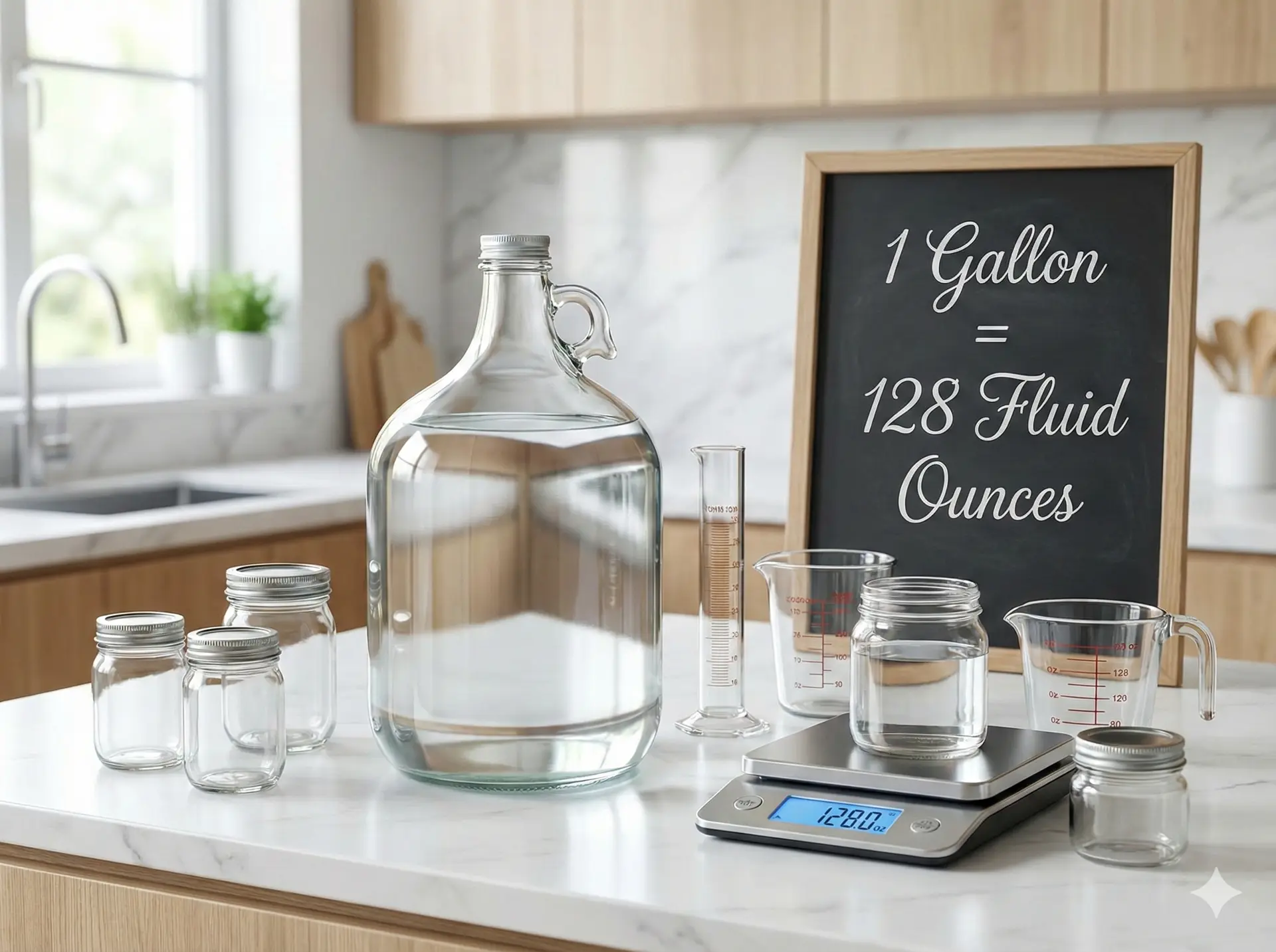
A gallon is a unit of measurement that is commonly used in the United States to measure liquids, such as water, milk, and juice. I think it's interesting to note that the term "gallon" originated from the Old French word "galon," which referred to a large container used for measuring liquids. A gallon is equivalent to 128 fluid ounces, or 16 cups. On the other hand, an ounce is a smaller unit of measurement that is often used to measure ingredients in recipes, as well as the weight of objects.
An ounce can be further divided into smaller units, such as fluid ounces and weight ounces. Fluid ounces are used to measure liquids, while weight ounces are used to measure the weight of dry ingredients, such as flour and sugar. I think it's worth mentioning that the distinction between fluid and weight ounces is important, as it can affect the accuracy of your measurements. For example, if a recipe calls for 8 ounces of flour, you'll need to use a digital scale to measure the weight of the flour, rather than a liquid measuring cup.
Understanding the definitions of gallons and ounces is essential for making accurate conversions. I think it's helpful to think of gallons and ounces as being part of a larger system of measurement, with each unit having its own specific uses and applications. By familiarizing yourself with these units, you'll be better equipped to tackle a wide range of tasks, from cooking and baking to science and engineering.

How Many Ounces in a Gallon
So, how many ounces are in a gallon? The answer is simple: there are 128 ounces in a gallon. This conversion is based on the definition of a gallon as 128 fluid ounces, and it's a fundamental concept that you'll need to understand in order to make accurate conversions. I think it's helpful to memorize this conversion, as it will save you time and effort in the long run.
The conversion formula is straightforward: 1 gallon = 128 ounces. You can use this formula to convert gallons to ounces, or vice versa. For example, if you need to convert 2 gallons to ounces, you can simply multiply 2 by 128, which gives you 256 ounces. I think it's worth noting that this conversion is a simple one, but it's also a critical one, as it can affect the accuracy of your measurements and the quality of your final product.
In addition to memorizing the conversion formula, I think it's also helpful to understand the context in which you'll be using gallons and ounces. For example, if you're working in a kitchen, you'll need to be able to convert between gallons and ounces quickly and accurately, in order to measure ingredients and follow recipes. By understanding the relationship between gallons and ounces, you'll be better equipped to tackle a wide range of tasks, from cooking and baking to fluid measurements.
Practical Applications of Gallon to Ounce Conversions
Gallon to ounce conversions have many practical applications, particularly in the kitchen. I think it's interesting to note that cooking and baking often require precise measurements, and understanding how to convert between gallons and ounces can help you achieve accurate results. For example, if a recipe calls for 1 gallon of milk, you'll need to convert this to ounces in order to measure it accurately.
Cooking and baking are not the only contexts in which gallon to ounce conversions are useful. Fluid measurements, such as measuring the amount of water in a pool or the amount of juice in a container, also require accurate conversions. I think it's worth mentioning that fluid measurements can be tricky, as they often involve converting between different units, such as gallons, ounces, and liters.
In addition to cooking, baking, and fluid measurements, gallon to ounce conversions also have applications in science and engineering. For example, scientists may need to measure the volume of a liquid in order to conduct an experiment, while engineers may need to calculate the flow rate of a fluid in order to design a system. I think it's helpful to think of gallon to ounce conversions as a fundamental concept that has many practical applications, and that can be used in a wide range of contexts.
By understanding how to convert between gallons and ounces, you'll be better equipped to tackle a wide range of tasks, from cooking and baking to science and engineering. I think it's worth noting that practice and experience are key to mastering gallon to ounce conversions, and that the more you practice, the more confident you'll become.
Common Mistakes in Gallon to Ounce Conversions
Despite the simplicity of the conversion formula, many people make mistakes when converting between gallons and ounces. I think it's worth noting that unit confusion is a common mistake, particularly when working with fluid measurements. For example, if you're measuring the amount of water in a pool, you may need to convert between gallons and liters, rather than ounces.
Calculation mistakes are another common error, particularly when working with large or small numbers. I think it's helpful to double-check your calculations, in order to ensure that you're getting accurate results. For example, if you need to convert 3 gallons to ounces, you'll need to multiply 3 by 128, which gives you 384 ounces.
In addition to unit confusion and calculation mistakes, I think it's also worth noting that a lack of practice and experience can also lead to mistakes. The more you practice converting between gallons and ounces, the more confident you'll become, and the less likely you'll be to make mistakes. I think it's helpful to start with simple conversions, such as converting 1 gallon to ounces, and then gradually move on to more complex conversions, such as converting 5 gallons to ounces.
Tools and Resources for Accurate Conversions
Fortunately, there are many tools and resources available to help you make accurate conversions between gallons and ounces. I think it's worth noting that online conversion calculators are a great resource, as they can quickly and accurately convert between different units. For example, you can use an online calculator to convert 2 gallons to ounces, or to convert 16 ounces to gallons.
In addition to online conversion calculators, mobile apps are also a great resource for making accurate conversions. Many apps, such as unit conversion apps, can convert between different units, including gallons and ounces. I think it's helpful to have a unit conversion app on your phone or tablet, as it can be a quick and easy way to make conversions on the go.
Finally, I think it's also worth noting that digital scales and measuring cups can also be helpful for making accurate conversions. These tools can help you measure ingredients and liquids accurately, and can be particularly useful in the kitchen. By using these tools and resources, you'll be better equipped to make accurate conversions, and to achieve precise measurements in a wide range of contexts.
Conclusion and Final Thoughts
In conclusion, understanding how to convert between gallons and ounces is a fundamental concept that has many practical applications. I think it's worth noting that accurate conversions are essential in many contexts, from cooking and baking to science and engineering. By mastering gallon to ounce conversions, you'll be better equipped to tackle a wide range of tasks, and to achieve precise measurements and accurate results.
I think it's also worth noting that practice and experience are key to mastering gallon to ounce conversions. The more you practice, the more confident you'll become, and the less likely you'll be to make mistakes. I think it's helpful to start with simple conversions, and then gradually move on to more complex conversions, in order to build your skills and your confidence.
Finally, I think it's worth noting that there are many tools and resources available to help you make accurate conversions. From online conversion calculators to mobile apps, and from digital scales to measuring cups, these tools can help you achieve precise measurements and accurate results. By using these tools and resources, and by practicing and building your skills, you'll be well on your way to becoming a master of gallon to ounce conversions.
So, the next time you're faced with a recipe that calls for 1 gallon of milk, or a science experiment that requires you to measure the volume of a liquid, you'll be confident in your ability to make accurate conversions. And who knows - you may even find that you enjoy the challenge of converting between gallons and ounces, and that you develop a new appreciation for the importance of accurate measurements in your daily life.
Key Takeaways
In summary, the key takeaway from this article is that understanding how to convert between gallons and ounces is a fundamental concept that has many practical applications. By mastering gallon to ounce conversions, you'll be better equipped to tackle a wide range of tasks, from cooking and baking to science and engineering. So, the next time you're faced with a conversion challenge, will you be ready to rise to the occasion, or will you find yourself struggling to keep up? The choice is yours - but with practice, patience, and the right tools and resources, I think you'll find that you're capable of achieving anything you set your mind to.
Frequently Asked Questions
Related Articles
How Many Feet in a Mile
Have you ever found yourself wondering how many feet are in a mile? Perhaps you're a runner trying to track your progress, a contractor estimating materials for a construction project, or simply someone who's curious about the world around you. Whatever your reason, understanding the relationship b

How Much Sleep Do I Need
Have you ever wondered how much sleep you really need? I think it's a question we've all asked ourselves at some point, especially after a long night of tossing and turning. You might be surprised to learn that the amount of sleep you need can vary greatly depending on your age, lifestyle, and othe
How Much Water Should I Drink
Have you ever found yourself feeling sluggish, tired, and struggling to focus, only to realize that you haven't had a glass of water all day? You're not alone. Many of us underestimate the importance of staying hydrated, and it can have a significant impact on our overall health and wellbeing. As y
How Many Ounces in a Cup
Did you know that a staggering 75% of home cooks in the United States use cups as their primary unit of measurement when following recipes? This statistic, reported by the National Kitchen and Bath Association, highlights the importance of understanding the relationship between cups and ounces. As