Sri Lanka IMF EFF Program 2026: Key Reforms and Impacts on Businesses
As we navigate 2026, Sri Lanka's IMF Extended Fund Facility (EFF) programme stands as a cornerstone of our economic revival, delivering vital funds and pushing through reforms that stabilise our finan
The Lankawebsites editorial team curates, fact-checks, and updates guides on personal finance, property, health, immigration, legal, business, and lifestyle topics relevant to Lankawebsites readers. Articles are produced with AI assistance and reviewed by the editorial team before publication.
As we navigate 2026, Sri Lanka's IMF Extended Fund Facility (EFF) programme stands as a cornerstone of our economic revival, delivering vital funds and pushing through reforms that stabilise our finances amid challenges like Cyclone Ditwah. For businesses across Colombo, Kandy, and beyond, understanding these Sri Lanka IMF 2026 developments means spotting opportunities in a recovering economy while preparing for IMF reforms Sri Lanka that reshape taxes, trade, and operations.
What is the IMF EFF Programme and Where Do We Stand in 2026?
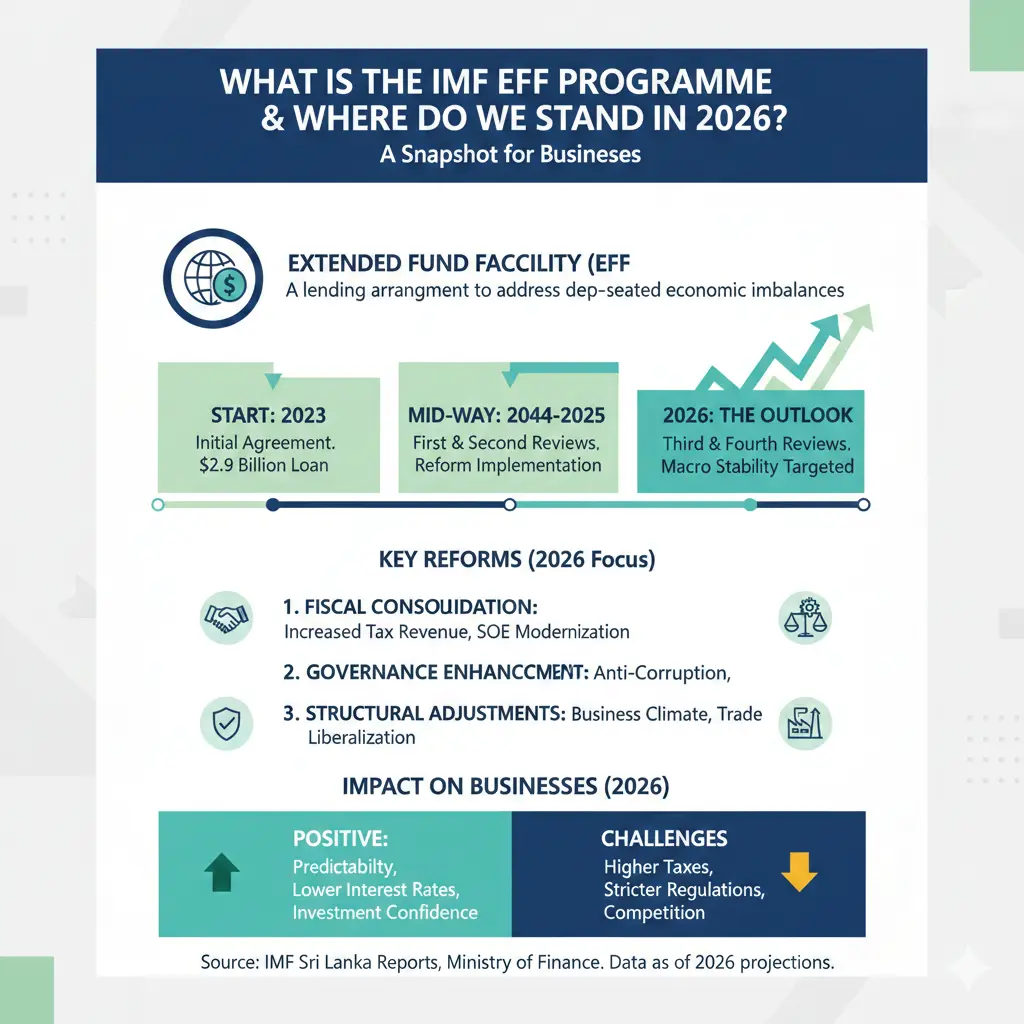
The IMF's EFF is a four-year arrangement worth SDR 2.3 billion (about US$3 billion) approved on 20 March 2023 to help Sri Lanka recover from the 2022 crisis. By early 2026, we've seen strong performance: inflation nearing targets, reserves building up, and GDP growth exceeding expectations despite setbacks.
Cyclone Ditwah in late 2025 disrupted progress, leading to a US$206 million Rapid Financing Instrument (RFI) approval for urgent relief while deferring the Fifth Review under EFF. Discussions resumed in early 2026, with staff-level agreement reached on the Fifth Review, unlocking US$347 million upon Executive Board approval—contingent on the 2026 Appropriation Bill and debt restructuring assurances.
The government aims to bundle the sixth and seventh tranches for faster access, targeting mid-2026 reviews after cyclone delays. This keeps our EFF on track without changes, as confirmed in January 2026 talks.
Key Milestones Achieved So Far
- Fiscal Consolidation: Revenue mobilisation outperforms targets through better tax compliance.
- External Resilience: Reserves rebuilt amid global uncertainties.
- Debt Restructuring: Substantial relief secured, placing public debt on a sustainable path.
- Cyclone Response: Rs. 500 billion supplementary budget funded from treasury surplus, praised by IMF.
Core IMF Reforms Shaping Sri Lanka in 2026
These IMF reforms Sri Lanka focus on macroeconomic stability, governance, and growth. Here's what businesses need to know.
Fiscal and Tax Reforms
The 2026 Budget must align with programme parameters: broaden the tax base, curb leakages via stricter exemption frameworks, and boost compliance. Expect digitalisation in revenue administration to fight corruption, alongside anti-corruption measures.
For businesses, this means tighter audits but fairer systems. Inland Revenue Department (IRD) enhancements will prioritise high-quality spending, reducing arrears and improving public financial management. Practical tip: Update your tax filings now using IRD's online portal (ird.gov.lk) to avoid penalties under new compliance rules.
Governance and Anti-Corruption Drives
Speed up procurement reforms, strengthen AML/CFT (Anti-Money Laundering/Combating the Financing of Terrorism) frameworks, and implement electronic asset declarations. Accelerate recruitment at the Commission to Investigate Allegations of Bribery or Corruption (CIABOC) per the Anti-Corruption Act, safeguarding its independence.
Operationalise the Public Debt Management Office for prudent borrowing—a win for investor confidence. Businesses tendering for government contracts should align with these transparent procurement standards to secure deals.
Social Protection and Structural Changes
Refine welfare schemes for better targeting of the vulnerable, ensuring fiscal space for recovery. Structural reforms aim to lift potential growth, including public investment management to prioritise reconstruction post-Ditwah.
"Advancing reforms is key to ensuring macroeconomic stability, anchoring the recovery, and equipping Sri Lanka to better withstand external shocks."
Impacts on Sri Lankan Businesses in 2026
These reforms bring stability but demand adaptation. Positive signs include price stability and reserve growth, easing import costs for exporters in apparel and tea sectors.
Opportunities for Growth
- Export Boost: Stronger reserves mean reliable dollar access; tourism and IT firms benefit from global confidence.
- Government Contracts: Reformed procurement opens doors for compliant SMEs in reconstruction—target cyclone-hit areas like eastern provinces.
- Investment Inflows: Debt sustainability restores ISB investor trust, potentially lowering borrowing costs.
Challenges and How to Navigate Them
Tighter taxes hit profit margins, especially for informal traders. Cyclone recovery adds supply chain risks, but IMF notes our fiscal buffer handled Rs. 500 billion extra spending commendably.
| Reform Area | Business Impact | Actionable Advice |
|---|---|---|
| Tax Base Broadening | Higher compliance costs | Consult IRD for VAT exemptions; use e-invoicing by Q2 2026 |
| Procurement Reforms | Competitive tenders | Register on National Procurement Portal (npp.gov.lk) |
| Debt Management | Stable financing | Explore BOI incentives for exports (investsrilanka.com) |
| AML/CFT Strengthening | Due diligence needs | Train staff via Central Bank guidelines (cbsl.gov.lk) |
SMEs in manufacturing should eye capital spending ramps, as IMF pushes efficient public investment. Retailers in urban centres like Pettah can leverage inflation control for steady pricing.
2026 Targets: What Lies Ahead
Secure Board approval for Fifth Review, finalise bilateral debt deals, and pass the 2026 Appropriation Bill. Government eyes simultaneous sixth/seventh tranches mid-year. Amid geopolitical risks, sustaining reform momentum is crucial.
Businesses: Monitor Central Bank updates (cbsl.gov.lk) and Treasury portals for budget details. Join Ceylon Chamber of Commerce webinars on IMF compliance for peer insights.
Next Steps for Businesses and Locals
Stay ahead: Review your operations against IMF fiscal rules, upskill on governance reforms via CIABOC resources (ciaboc.gov.lk), and diversify amid uncertainties. Track official updates from the Finance Ministry (treasury.gov.lk) and IMF site. With strong performance, 2026 could mark our full recovery—let's seize it together.
Frequently Asked Questions
Sources & References
- 1
-
2
Sri Lanka reaches deal with IMF to continue EFF without any changes — economynext.com
- 3
-
4
Govt Aims to Secure Sixth and Seventh IMF Installments Simultaneously — lankanewsweb.net
- 5
- 6
Related Articles

Fiscal Policy Reforms Sri Lanka Post-2022 Crisis: Lessons for 2026 Businesses
Remember the dark days of 2022, when fuel queues stretched for kilometres and ATMs ran dry? We've come a long way since Sri Lanka's economic crisis forced a debt default and sparked nationwide unrest

Comparing Sri Lanka's 2025 vs 2026 Monetary Policies: Key Shifts
Sri Lanka's monetary policy landscape has shifted significantly between 2025 and 2026, moving from aggressive easing to a more measured approach. Understanding these changes is crucial for anyone plan

Navigating Sri Lanka's 2026 Trade Deficit Policies: Import vs Export Balance
Sri Lanka's trade deficit has become one of the most pressing economic challenges facing our nation in 2026. With a deficit of $997.2 million in December 2025[1], significantly wider than the $720 mil

2026 Outlook: Sri Lanka Government Revenue Growth Policies Post-110% Rise
Sri Lanka's government revenue has surged an impressive 110% in recent years, signalling a robust economic recovery that's got everyone talking—from Colombo's business districts to rural markets in th