The Barred Kukri Snake: Endemic Serpent
Imagine you're hiking through the misty hills of the Knuckles Range or tending your garden in the dry zone—suddenly, a slender snake with striking black bands catches your eye. This is the Barred Kukr
The Lankawebsites editorial team curates, fact-checks, and updates guides on personal finance, property, health, immigration, legal, business, and lifestyle topics relevant to Lankawebsites readers. Articles are produced with AI assistance and reviewed by the editorial team before publication.
Imagine you're hiking through the misty hills of the Knuckles Range or tending your garden in the dry zone—suddenly, a slender snake with striking black bands catches your eye. This is the Barred Kukri Snake, a fascinating endemic serpent that's uniquely Sri Lankan, gliding silently through our forests and fields. Non-venomous and often misunderstood, it's a vital part of our island's biodiversity, helping control pests like earthworms and insects that plague our crops.
We've all heard stories of snakes in Lanka, but the Barred Kukri Snake stands out for its kukri-like curved teeth and harmless nature. In this guide, we'll explore its world, from identification to conservation, so you can appreciate and safely coexist with this endemic treasure in 2026.
What is the Barred Kukri Snake?
The Barred Kukri Snake, scientifically known as Oligodon calamarius or Templeton's Kukri Snake, is a non-venomous colubrid species endemic to Sri Lanka. Unlike its widespread cousin, the Common Kukri Snake (Oligodon arnensis), which spans South Asia including our island, the Barred Kukri is found nowhere else on Earth. Recent taxonomic studies confirm O. arnensis sensu stricto in southern India and Sri Lanka, but true endemics like O. calamarius are distinctly Lankan.
These snakes earn their "kukri" name from their unique, curved rear teeth resembling the Nepalese kukri knife—perfect for grasping slippery prey, not for harming humans. They're nocturnal hunters, active at dusk and night, which is why you'll rarely spot them basking like cobras.
Physical Description and Identification
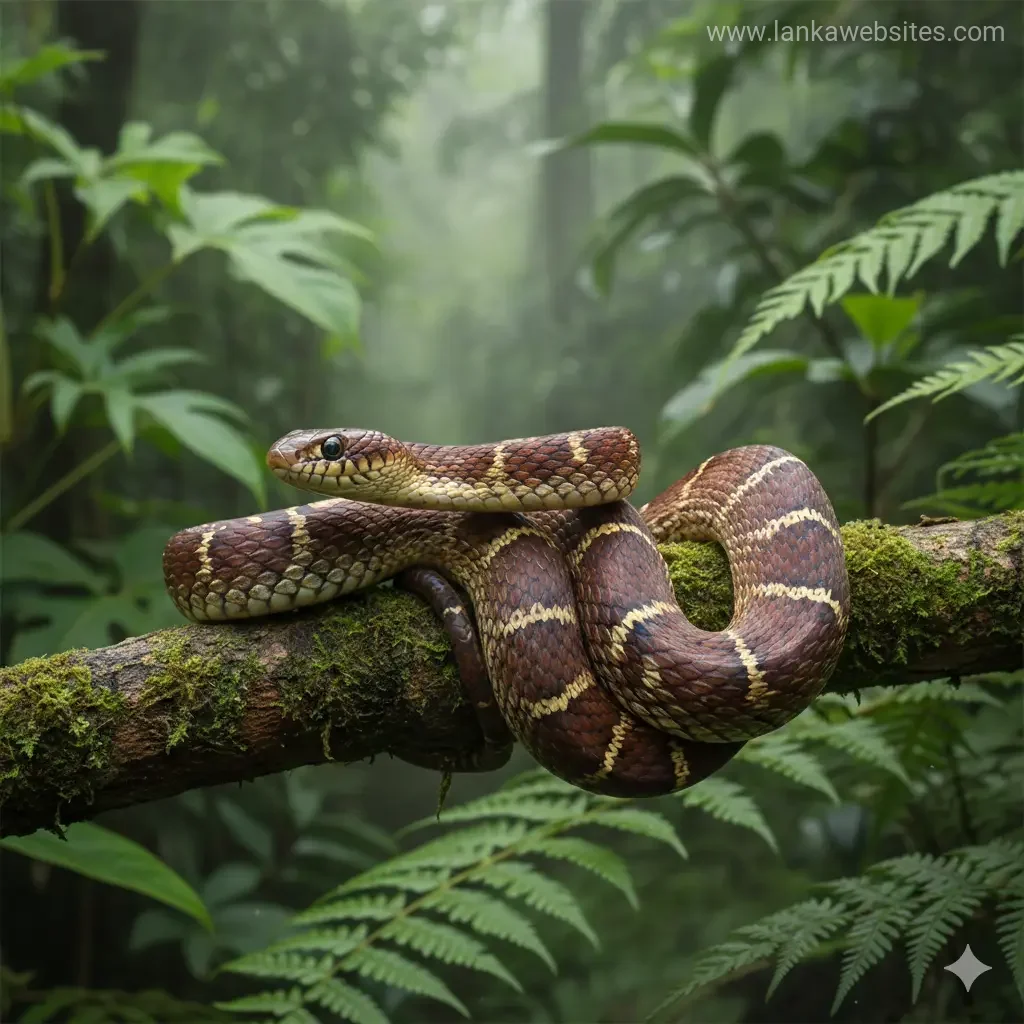
Adults typically reach 30-50 cm in length, with a slender, cylindrical body ideal for burrowing. The upper body is pale brown or orange, adorned with **well-defined black crossbands**—hence "barred"—that may be edged in white. Look for an angular black band between the eyes and another on the nape. The belly is uniform yellowish, occasionally spotted brown.
- Head:** Slightly distinct from neck, with a divided nasal scale and rostral visible from above.
- Scales:** Smooth colubrid scales; frontal scale as long as distance from snout end.
- Tail:** Short, about 15-20% of total length, tipped for sensing vibrations.
- Juveniles:** Brighter bands, more contrasting for camouflage in leaf litter.
In Sri Lanka's varied terrains, colour variations occur: drier specimens from the intermediate zone may appear more russet, while wet zone ones are paler. If you're in the field, don't confuse it with the venomous Banded Krait—kukris lack the krait's bold white-black rings and triangular head.
Habitat and Distribution in Sri Lanka
As an **endemic serpent**, the Barred Kukri Snake thrives exclusively in Sri Lanka's diverse ecosystems, from sea level to mid-hills. Prime spots include the wet zone's Sinharaja Forest Reserve, Knuckles Mountain Range, and dry zone scrublands around Yala and Wilpattu.
Preferred Environments
These snakes favour:
- Humid forests and home gardens with leaf litter for hunting earthworms.
- Moist soil near streams or rice paddies—common in Central Province.
- Elevations up to 1,500m, recorded in the Peak Wilderness Sanctuary.
In 2026, habitat loss from tea plantations and urban sprawl threatens populations, but protected areas like the Rakwara Forest Reserve harbour healthy numbers. During monsoon (May-October), they burrow deeper; in dry seasons, seek shaded crevices.
Behaviour and Ecology
Nocturnal by nature, Barred Kukri Snakes emerge to feed on earthworms, insect larvae, and small invertebrates—natural pest controllers for our vegetable farms. They're shy, fleeing into burrows when disturbed, and use no aggressive defence beyond musking (releasing a foul odour).
Diet and Hunting
With kukri teeth, they slash and extract earthworm innards efficiently. In Lanka's rice fields, they reduce pest populations, indirectly supporting farmers without chemicals. Breeding occurs post-monsoon; females lay 4-8 eggs in humid soil, hatching in 45-60 days.
They're resilient climbers, often found in low shrubs, aiding seed dispersal indirectly via habitat maintenance.
Interaction with Humans: Safety and Encounters
Good news for us locals: the Barred Kukri Snake is **completely non-venomous** and poses no threat. Bites are rare, causing only minor scratches. If encountered in your backyard in Kandy or Galle:
- Stay calm—don't grab or kill.
- Observe from distance; it'll hide quickly.
- Use a stick to guide it away gently.
Legal Protection in Sri Lanka
Under the **Fauna and Flora Protection Ordinance (No. 22 of 1937, amended 2026)**, all native snakes are protected; killing them carries fines up to LKR 50,000 or imprisonment. Report sightings to the Department of Wildlife Conservation (DWC) via their hotline 1926 or app for citizen science. In 2026, DWC's "Snake Safe Lanka" initiative educates on safe coexistence.
Nearby hospitals like the Angampora Snakebite Unit in Kurunegala handle any rare incidents, but kukris don't require antivenom.
Conservation Status and Threats
Not yet IUCN-listed as of 2026, but as an endemic, it's vulnerable to:
- Habitat destruction:** Deforestation for gems in Ratnapura.
- Roadkill:** On highways like Colombo-Kandy.
- Pesticides:** Reducing prey in farmlands.
Join efforts: Support WildAid Lanka or report to iNaturalist.org for mapping. Community gardens with native plants boost populations locally.
Practical Tips for Locals
Spotting a Barred Kukri? Here's actionable advice:
- Garden-proofing:** Clear leaf litter weekly; install snake-proof fencing (mesh <1cm).
- Eco-friendly farming:** Avoid broad-spectrum insecticides; encourage earthworm balance.
- Citizen science:** Snap ethical photos (no flash), upload to WildLanka app.
- Education:** Teach kids: "Observe, don't disturb."
In urban Colombo suburbs, they've adapted to parks— a sign of resilience.
FAQ
Is the Barred Kukri Snake venomous?
No, it's harmless to humans, feeding only on invertebrates.
Where can I see one in Sri Lanka?
Sinharaja, Knuckles, or your garden during rains—respect protected areas.
What if it bites me?
Wash with soap; seek medical check if swelling occurs. No antivenom needed.
Can I keep it as a pet?
No, illegal under DWC laws; wild populations need them.
How does it help farmers?
Eats crop-damaging worms, reducing need for chemicals.
What's the difference from Common Kukri?
Barred is endemic (O. calamarius); Common (O. arnensis) is regional.
Spot, Protect, Appreciate
The Barred Kukri Snake embodies Lanka's rich endemic wildlife—vital, harmless, and worth safeguarding. Next time you tread our trails, pause to admire this barred beauty. Get involved: Download the DWC app, join a nature walk with the Field Ornithology Group of Sri Lanka, or plant leaf litter habitats. Together, we'll ensure this serpent slithers on for generations.
Related Articles

Sri Lankan Leopard: Apex Predator and Conservation Icon
Introduction to the Sri Lankan Leopard The Sri Lankan leopard is an awe-inspiring creature that roams the forests and grasslands of Sri Lanka. As an apex

Sri Lankan Junglefowl: National Bird of Sri Lanka
Introduction to the Sri Lankan Junglefowl The Sri Lankan Junglefowl is a colourful and fascinating bird species that has captivated the hearts of many wild

Ceylon Frogmouth: Nocturnal Endemic Bird
Introduction to the Ceylon Frogmouth The Ceylon Frogmouth is a fascinating, nocturnal bird that is endemic to Sri Lanka, but in this article, we will be di

Sri Lanka Whipping Frog: Colorful Tree Frog
Introduction to the Sri Lanka Whipping Frog The Sri Lanka Whipping Frog, also known as the Taruga eques, is a colourful tree frog that is native to the bea