Foreign Direct Investment Boom: China, India, UAE Projects Transforming Sri Lankan Corporates
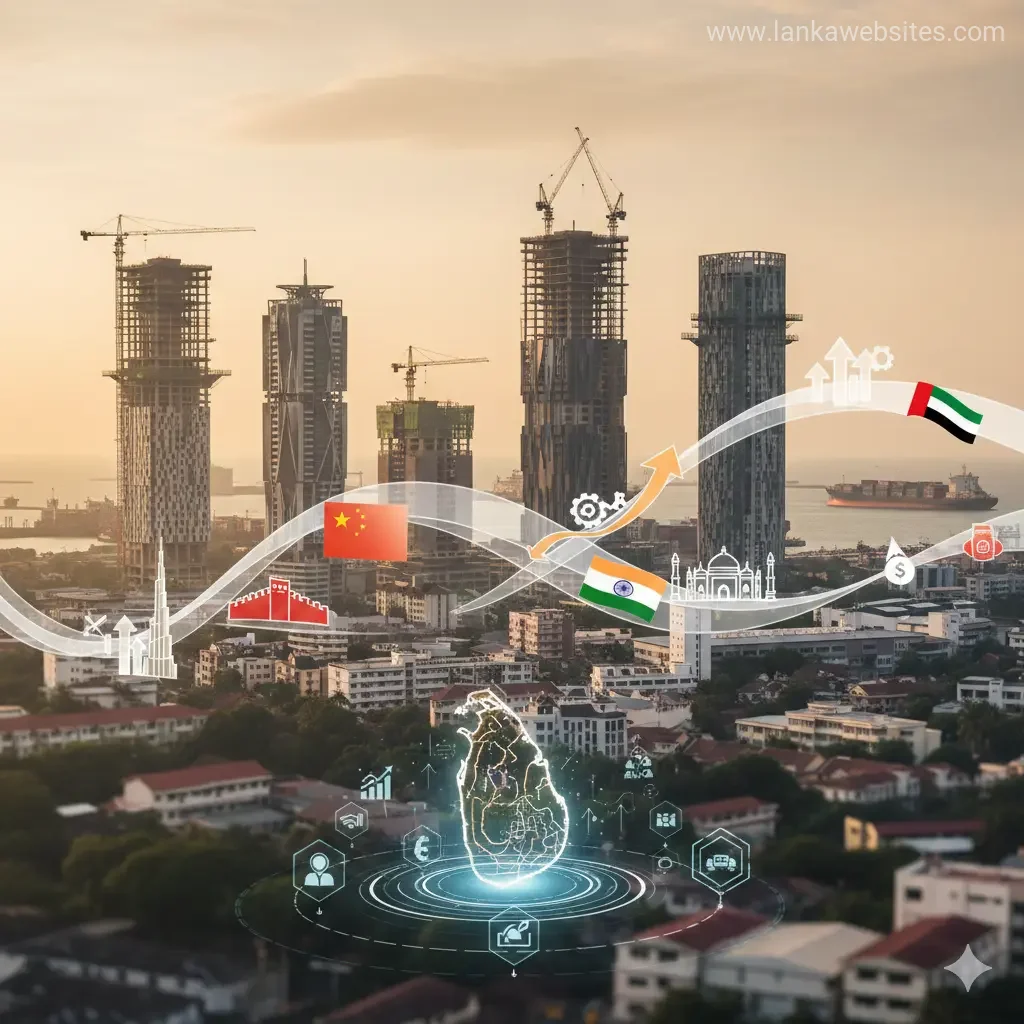
Sri Lanka's $2 billion FDI target for 2026 driven by China, India, and UAE investments creates unprecedented opportunities for local corporates in manufacturing and infrastructure.
The Lankawebsites editorial team curates, fact-checks, and updates guides on personal finance, property, health, immigration, legal, business, and lifestyle topics relevant to Lankawebsites readers. Articles are produced with AI assistance and reviewed by the editorial team before publication.
Sri Lanka's foreign direct investment landscape is experiencing remarkable momentum in 2026, with the government targeting between USD 1.5 and 2 billion in new capital inflows following 2025's breakthrough achievement of over USD 1 billion . This surge in international confidence, led by strategic investments from China, India, and the UAE, is transforming our corporate sector and creating unprecedented partnership opportunities for local businesses across manufacturing, infrastructure, energy, and services sectors.
The 2025 Foundation: Breaking the Billion-Dollar Barrier
The Board of Investment of Sri Lanka (BOI) achieved a significant milestone in 2025, surpassing USD 1 billion in foreign direct investment—a 72% increase compared to 2024 . This performance reflects renewed global investor confidence supported by improving macroeconomic stability, clearer policy direction, and an enhanced investment facilitation framework . Of the USD 1,057 million total, USD 167 million came through equity capital, USD 213 million from re-investments, USD 567 million via intra-company borrowings, and USD 110 million through foreign commercial borrowings .
Sectoral Distribution and Source Countries
The manufacturing sector contributed 46% of FDI inflows in 2025, followed by port development at 26% and tourism at 11% . Singapore, India, France, Netherlands, and Luxembourg emerged as the top five source countries for foreign investment . During 2025, the BOI granted approval for 146 investment projects worth USD 1,906 million total investment value, including 70 new projects and 76 expansion projects, with USD 896 million expected to flow in as foreign capital .
China's Continued Dominance: Port City Colombo
China Harbour Engineering Company (CHEC) announced a fresh USD 300 million foreign direct investment into Port City Colombo in January 2026, earmarked for Phase II development . This follows an earlier USD 1.25 billion invested in land reclamation and infrastructure, making Port City one of the largest single Chinese-backed urban developments in South Asia . CHEC describes the project as a "generational project" rather than speculative real estate, with Phase II funding expanding internal infrastructure, utilities, and core services within Sri Lanka's first multi-services Special Economic Zone (SEZ) .
Hambantota Port Integration
The China-backed Hambantota International Port has boosted its container handling capacity to one million twenty-foot equivalent units (TEUs) annually, with a feeder service to Colombo expected shortly . Chief Executive Wilson Qu stated that new crane investments will considerably enhance container handling capabilities, positioning Hambantota as a fully-fledged multipurpose port crucial for transshipment operations and attracting investors looking to establish manufacturing plants in the industrial zone . Combined with Colombo, Sri Lanka will reach a capacity of 10 million TEUs in 2025/2026 .
India-UAE Energy Partnership: Trincomalee Hub
India and the United Arab Emirates signed a landmark Memorandum of Understanding with Sri Lanka in April 2025 to develop Trincomalee into a regional energy hub . The agreement was formalised during Prime Minister Narendra Modi's visit to Colombo, marking the first visit by a global leader since President Anura Kumara Dissanayake assumed office . The project will involve building a multi-product pipeline and may incorporate a World War II-era tank farm partially owned by the Sri Lankan subsidiary of Indian Oil Corporation .
Strategic Significance and UAE Role
Foreign Secretary Vikram Misri highlighted the UAE's significance as a strategic partner for India in the energy sector, stating this collaboration is a first for the region . Mohamed Hassan Alsuwaidi emphasised the MoU exemplifies the UAE's commitment to strategic regional partnerships that promote diplomacy, long-term economic resilience, and sustainable infrastructure development . The project aims to unlock Trincomalee's full potential as a vital energy and logistics gateway for South Asia, with a joint venture company expected to implement and oversee the multibillion-dollar development .
India's Manufacturing and Financial Support
The Government of India proposed a total of 4 billion Indian Rupees in grants and loans to Sri Lanka through the 2026/27 Budget . India's Finance Minister Nirmala Sitharaman laid out priorities for Asia's third-biggest economy, focusing on structural reforms particularly in the manufacturing sector, building a robust financial sector, and stepping up investments in cutting-edge technologies including artificial intelligence . Prime Minister Modi also inaugurated a USD 100 million solar power project during his visit, a joint venture involving the Ceylon Electricity Board and India's National Thermal Power Corp .
Debt Restructuring Completion
Sri Lanka has completed its debt restructuring process, with the country owing around USD 1.36 billion to the EXIM Bank of India and the State Bank of India, according to the Sri Lanka Finance Ministry . This restructuring, coupled with India's approximately USD 4 billion in financial assistance provided during Sri Lanka's financial crisis that began in 2022, demonstrates the depth of bilateral economic ties and India's strategic commitment to our economic recovery .
Investment Targets and Economic Growth
Minister of Labour and Deputy Minister of Finance and Planning Dr. Anil Jayantha Fernando announced the government's goal to attract between USD 1.5 and USD 2 billion in foreign investment in 2026 . He emphasised that although economic growth had initially been forecast at around 3.5% for 2025, the year ended with a growth rate of 5% . President Anura Kumara Dissanayake stated the government anticipates economic growth exceeding 4% in 2026, requiring facilities to attract and sustain foreign direct investments .
Infrastructure Investment Allocation
Looking ahead to 2026, the government allocated Rs. 4,480 billion for public investment, with strong focus on implementation, particularly in building critical national infrastructure . Of the total Rs. 500 billion allocated for the disaster relief package, Rs. 250 billion has been specifically earmarked for infrastructure-related projects to accelerate economic growth . BOI Chairman Arjuna Herath cited the recent recovery of Sri Lanka's business sector from cyclone Ditwah as a reason for the country's positive outlook, noting that more than 90% of companies that experienced operational disruptions have now resumed normal business operations .
Opportunities for Sri Lankan Corporates
Local businesses can position themselves as suppliers, service providers, and joint venture partners for major foreign investors arriving through the FDI boom. Manufacturing companies benefit from supply chain integration opportunities with international firms setting up production facilities, particularly in sectors like apparel, food processing, pharmaceuticals, and high-value manufacturing . Port City Colombo's SEZ framework offers local financial services, legal firms, accounting practices, and business consultancy opportunities to serve international companies establishing regional headquarters .
Infrastructure and Construction Partnerships
The expansion of Hambantota and Colombo ports, development of Trincomalee energy hub, and Port City infrastructure projects require local construction contractors, engineering firms, equipment suppliers, and logistics providers . Sri Lankan companies with expertise in utilities installation, road construction, facility management, and specialised services find partnership opportunities with Chinese, Indian, and UAE developers implementing these megaprojects. The government sees manufacturing investments as critical to strengthening Sri Lanka's industrial base, generating employment, and rebuilding investor confidence .
BOI Transformation and Investment Facilitation
The BOI launched the BOI Accelerator Program in 2026, setting out a clear strategy and roadmap supported by a two-year action plan aimed at strengthening institutional capacity, enhancing investor facilitation services, and positioning the BOI as a globally competitive and investor-friendly agency . In collaboration with the Asian Development Bank (ADB), the BOI developed comprehensive policy and strategy frameworks for Investment Promotion, Investment Project Evaluation, and a Policy on Land Allotment .
Structured Investment Opportunities
The BOI launched a new initiative to identify, develop, and promote "Structured Investment Opportunities", with 20 structured projects announced in the first phase supported by a targeted and vigorous promotion campaign to attract sustainable and high-quality investors . The BOI recruited Management Trainees with diversified skill sets in 2025 and secured approvals to fill critical vacant cadre positions whilst continuing sustained training and development together with empowerment of management . These institutional improvements streamline approval processes and strengthen close coordination with line ministries and regulatory agencies .
Navigating the Investment Environment
Sri Lanka's strategic geographic position, highly literate workforce (97% literacy rate—the highest in South Asia), and wide array of incentive packages for foreign investors continue attracting well-known foreign companies . The BOI provides incentives and assists international investors to set up operations, particularly targeting manufacturing (high value-added/high tech), Business Processing Outsourcing (BPO), Knowledge Processing Outsourcing (KPO), IT-enabled services, hospitality, food processing, logistics, education, large-scale infrastructure, pharmaceutical, agriculture, and transport infrastructure sectors .
Challenges and Policy Considerations
Despite strong investment momentum, policy clarity remains essential for sustained FDI growth. Investors demand certainty on tax regimes, capital repatriation, dispute resolution, and regulatory independence . The government must clearly articulate how special economic zones like Port City will be insulated from domestic political interference and ideological experimentation to maintain investor confidence . Competing regional hubs like Dubai, Abu Dhabi, and India's GIFT City offer regulatory certainty, tax stability, and autonomous financial courts, setting high standards for investment environments .
Practical Steps for Sri Lankan Businesses
Register with the BOI and monitor their structured investment opportunities programme to identify potential partnerships with incoming foreign investors . Develop capabilities in sectors prioritised by major source countries—manufacturing for Singapore and India, port services for China, energy infrastructure for UAE partnerships . Attend BOI-organised investor meetings and industry consultations to network with foreign companies exploring Sri Lankan operations. Strengthen financial capacity and corporate governance to meet international partnership standards expected by multinational corporations .
Sector-Specific Positioning
Manufacturing firms should pursue supply agreements and component production contracts with foreign companies establishing plants, particularly in apparel, pharmaceuticals, and food processing . Service providers including legal, accounting, recruitment, training, facility management, and business consultancy should develop expertise in international corporate requirements and SEZ regulations . Technology companies can explore partnerships for BPO, KPO, and IT-enabled services as foreign investors seek local technical talent . Construction and engineering firms should bid on subcontracts for megaprojects whilst building capabilities in specialised infrastructure development .
Looking Forward: Sustainable Growth
The government's FDI target of USD 1.5-2 billion for 2026 appears achievable given the USD 896 million pipeline of approved projects expected to flow in as foreign capital from 2025 approvals . Several significant investment projects are in the pipeline as the BOI remains firmly committed to attracting new investors whilst supporting expansion of existing ones, ensuring sustainable, inclusive, and long-term economic growth . Sri Lankan corporates that position themselves strategically, develop international partnership capabilities, and align with priority sectors will benefit most from this transformative period in our economic development.
Frequently Asked Questions
Sources & References
- 1
-
2
Board of Investment of Sri Lanka - FDI Success 2025 — www.dgi.gov.lk
-
3
China Pumps Millions into Colombo Port City — lankanewsweb.net
- 4
-
5
India and UAE Collaborate to Establish Energy Hub in Sri Lanka — news.uppersetup.com
-
6
India and UAE Energy Hub Agreement During PM Modi's Visit to Sri Lanka — news.uppersetup.com
-
7
India, UAE to Build Energy Hub in Sri Lanka's Trincomalee — www.indiablooms.com
-
8
UAE, India, Sri Lanka Sign Landmark MoU to Transform Trincomalee — www.gulfarticles.com
- 9
-
10
President Dissanayake on Economic Growth and FDI Requirements — www.newsfirst.lk
-
11
Sri Lanka Expects Foreign Investment to Top 1.5 Billion USD in 2026 — english.news.cn
-
12
Investment Opportunities in Sri Lanka — www.srilanka.org.tr
Related Articles

Starting a Private Limited Company in Sri Lanka 2026: Step-by-Step Guide
Thinking about turning your business idea into a reality in Sri Lanka? Registering a **private limited company** gives you limited liability protection, credibility with banks and partners, and a soli

IMF Debt Targets for Sri Lanka: How Corporations Can Navigate 95% GDP Reduction by 2032
Sri Lanka's path to economic recovery hinges on meeting tough IMF debt targets, including slashing public debt to 95% of GDP by 2032. For corporations, this means rethinking debt strategies amid tight

KPMG Budget 2026 Insights: Key Impacts on Sri Lankan Corporate Reserves
As corporate leaders in Sri Lanka navigate the uncertainties of 2026, KPMG's sharp analysis of the Budget reveals critical shifts that could reshape how we manage our reserves. With foreign reserves h

Agriculture-to-Corporate Supply Chains: Leveraging 3.6% Sector Growth in 2026
Sri Lanka's agricultural sector is experiencing a pivotal moment in 2026. With steady growth momentum and an increasingly modernised supply chain, businesses and entrepreneurs across the island have u