Top Visa and Migration Scams Targeting Sri Lankans – and How to Avoid Them

Imagine selling your family's jewellery and taking a massive loan, only to watch your dreams of a better life abroad vanish as the agent disappears with Rs. 12.8 million. This heartbreaking story from
The Lankawebsites editorial team curates, fact-checks, and updates guides on personal finance, property, health, immigration, legal, business, and lifestyle topics relevant to Lankawebsites readers. Articles are produced with AI assistance and reviewed by the editorial team before publication.
Imagine selling your family's jewellery and taking a massive loan, only to watch your dreams of a better life abroad vanish as the agent disappears with Rs. 12.8 million. This heartbreaking story from Mannar is just one of many, with over 320 million rupees lost to visa scams targeting desperate Sri Lankans in 2024 alone. As our economy stabilises in 2026, the rush for jobs, studies, and opportunities overseas has made us prime targets for fraudsters. Don't let scammers steal your future—here's how to spot and dodge the top visa and migration traps.
Why Sri Lankans Are Falling Victim to Migration Scams
With over 300,000 of us migrating for work in 2024—mostly as construction labourers or domestic helpers—the demand for visas has exploded. Districts like Mannar, Mulaitivu, and Batticaloa have seen the worst, with 95 cases reported to the Special Crimes Investigation Bureau (SCIB) by October 2024. Fraudsters exploit our hopes, especially during tough times like the 2022 crisis when IT professionals were lured into cybercrime rings in Myanmar.
A survey of would-be student migrants revealed 100% knew about fake agencies from news reports, yet 75% skipped verifying their agent's legitimacy. Common red flags? Fake visas, hidden fees, and agents who ghost after payment. In one shocking case, an agent scammed clients out of Rs. 260 million and dumped 148 passports at Mattegoda police station.
The Surge in 2026: New Warnings from Authorities
Even into 2026, risks persist. Our Sri Lankan embassy in Russia has flagged fake education agencies promising student visa jobs, only to traffic victims into Ukraine. Closer to home, four Bangladeshi nationals were nabbed at Bandaranaike International Airport in November 2024 with forged Indian visas from a local scammer. Foreign Minister Vijitha Herath recently directed police and Immigration to crack down on short-term visa abusers involved in scams and money laundering, showing how interconnected these crimes are.
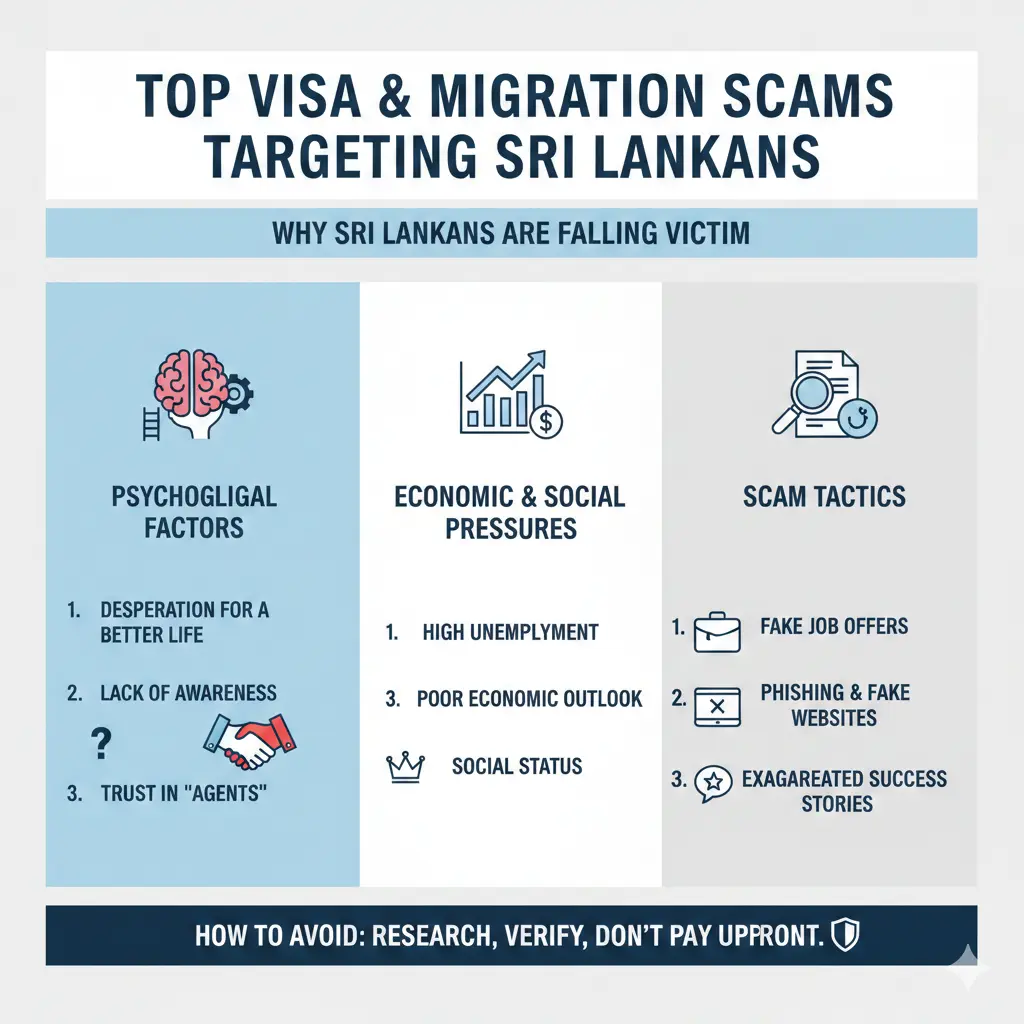
Top 5 Visa and Migration Scams Targeting Sri Lankans
Here's a breakdown of the most notorious scams we've seen, backed by real cases and official alerts.
1. Fake Migration Agents Promising Guaranteed Visas
Scammers pose as licensed agents offering "100% success" for Canada, Australia, or Europe. They charge exorbitant fees—often Rs. 1-13 million—then vanish. A Mannar fisherman lost everything to a Canadian visa con. Tip: Real agents can't guarantee visas; embassies decide based on your merits.
2. Bogus Online Visa Portals and e-Visa Scams
Fraudulent sites mimic official portals, charging triple the real price. One fake Sri Lanka e-Visa site tricked travellers into paying $139 USD instead of the official $50 USD for a 30-day tourist visa. Always use the genuine Department of Immigration and Emigration portal for Electronic Travel Authorizations (ETAs).
3. Job Offer and Study Visa Trafficking
High-paying "startup" jobs or student visas lead to cyber scam dens abroad. During the crisis, IT workers ended up in Myanmar crime syndicates. Students rely on family referrals without checks, paying steep fees for fake docs.
4. Hidden Fees and Document Forgery
Agents start cheap, then pile on "processing" costs. They supply counterfeit contracts or visas, like those caught at BIA. VFS Global data errors have caused visa rejections, blamed on sloppy handling.
5. Romance and Online Job Scams
WhatsApp or social media lures with romance, fake contracts, or work permits promising commissions. Canada's travel advisory warns these are rampant in Sri Lanka. Victims wire money for "visas" that never materialise.
How to Spot a Legitimate Migration Agent in Sri Lanka
Don't rely on word-of-mouth alone. Verify every agent through official channels.
- Check SLBFE Licensing: All legit foreign employment agents must be registered with the Sri Lanka Bureau of Foreign Employment (SLBFE). Search their database at slbfe.lk or call 1946.
- Demand Written Contracts: Insist on clear agreements detailing fees, services, and refunds. No vague promises.
- Avoid Upfront Mega-Payments: Pay in instalments, never sell assets without proof of progress.
- Verify Visas Directly: Contact embassies yourself. For student visas, confirm university offers independently.
- Report Suspicious Activity: Use SLBFE's hotline or SCIB for complaints.
Official Resources for Sri Lankans
The Department of Immigration and Emigration handles all visas—apply via immigration.gov.lk. For employment migration, SLBFE offers free awareness sessions nationwide. In 2026, they've ramped up campaigns urging background checks.
Practical Steps to Avoid Visa Scams: Actionable Tips
- Research Thoroughly: Use SLBFE's verified list. Google the agent's name + "scam" in Sinhala and Tamil too.
- Budget Realistically: Legit Canada work visas cost under Rs. 500,000 total, not millions.
- Secure Payments: Use bank transfers traceable to the agent's SLBFE account, never cash or hawala.
- Get Independent Advice: Consult free SLBFE counsellors before signing anything.
- Carry ID Always: Immigration rules require it, and it helps if detained over suspicions.
If scammed, report immediately to SLBFE (1946) or police. Recovery isn't guaranteed, but it stops others.
Stay Safe and Build Your Future Right
Visa scams thrive on our urgency, but with SLBFE verification and embassy checks, you can migrate confidently. Start today: visit slbfe.lk, attend a free session, and spread the word in your community. Your dream job or degree abroad is worth it—don't let fraudsters take it away. If in doubt, call 1946. Safe travels, Lanka!
Frequently Asked Questions
Sources & References
- 1
- 2
-
3
Fake Sri-Lanka Immigration & e-VISA Portal - Tripadvisor — www.tripadvisor.ca
-
4
Travel advice and advisories for Sri Lanka - Travel.gc.ca — travel.gc.ca
-
5
THE VISA SCAM IN SRI LANKA PART 2 - LankaWeb — www.lankaweb.com
Related Articles

Long-Distance Marriages: Practical Tips for Sri Lankans Working Overseas
This article references the following sources for accuracy and further reading:

Pathways for Sri Lankan Engineers to Work in Canada, Australia, and the Middle East
This article references the following sources for accuracy and further reading:

Specified Skilled Worker (SSW) Visa for Sri Lankans: Full 2026 Guide
This article references the following sources for accuracy and further reading:

Schooling Abroad: What Sri Lankan Parents Should Know Before Moving with Children
This article references the following sources for accuracy and further reading: