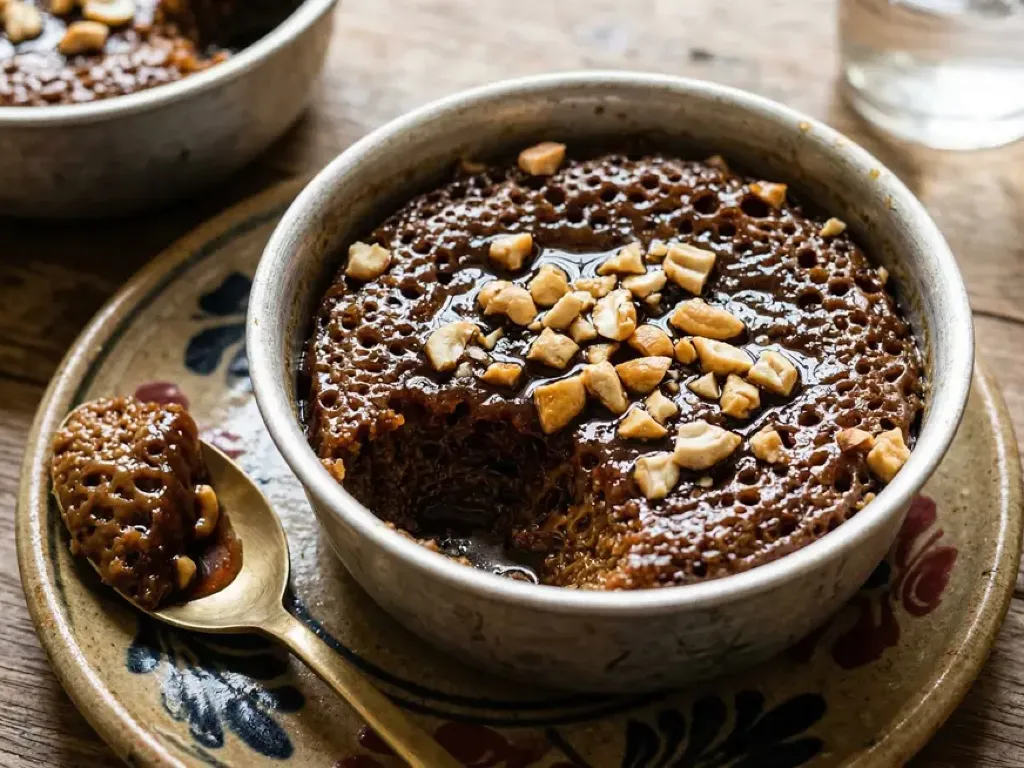
Watalappan - Sri Lanka's Signature Dessert
Ingredients
For the Jaggery Mixture
For the Custard
For the Spices
For Garnishing and Serving
Equipment
- Large pot for steaming (at least 5 litres capacity)
- 4 aluminium bowls or ramekins (4-5 inches diameter)
- Hand whisk
- Medium mixing bowl
- Small bowl
- Fine-mesh strainer
- Large jug
- Tongs
- Aluminium foil
- Heavy pot lid
Instructions
Prepare your steaming equipment by filling a large pot with water (about 5 cm deep) and bringing it to a rolling boil.
Tip: Use a pot large enough to accommodate your bowls with space around them for steam circulation.
Prepare 4 aluminium bowls (4-5 inches in diameter) or ramekins by lightly oiling the inside surfaces.
Tip: Stick to this bowl size for consistent cooking time. Smaller or larger bowls will affect the steaming duration.
In a small bowl, combine the broken jaggery pieces with 60 ml of hot water and stir until the jaggery dissolves into a thick paste with no lumps (it doesn't need to be completely smooth).
Tip: If using dark brown sugar, add a small amount of caramelised sugar to achieve the characteristic dark colour of authentic watalappan.
Let the jaggery mixture cool to room temperature (about 10 minutes) before proceeding.
Tip: This prevents the mixture from curdling the eggs when combined.
In a medium bowl, break the 4 whole eggs one by one into a small bowl to check freshness, then add them to the medium bowl along with the 2 egg yolks.
Tip: This ensures no shell fragments contaminate your mixture.
Using a hand whisk, lightly beat the egg mixture for 3-5 minutes, ensuring the yolks and whites are thoroughly mixed but not frothy.
Tip: Avoid using an electric beater as it creates too much air and foam, which affects the texture. Keep your movements gentle and avoid hitting the bottom of the bowl.
Add the cooled jaggery mixture to the eggs and whisk well until thoroughly combined and homogeneous.
Tip: Ensure no streaks of jaggery remain; the mixture should have a uniform pale-brown colour.
Add the cardamom powder (or crushed cardamom seeds), nutmeg, and salt to the mixture and whisk well.
Tip: If using whole cardamom pods, crush them gently with the back of a spoon to release the aromatic seeds before adding.
Pour the 480 ml of coconut milk into the mixture and whisk thoroughly until everything is well combined.
Tip: Ensure the coconut milk is fully incorporated with no streaks. If desired, you can pulse the mixture briefly in a blender for extra smoothness, but this is optional.
Have a large jug and fine-mesh strainer ready. Pour the watalappan mixture through the strainer into the jug to remove any lumps or air bubbles.
Tip: Straining is essential for achieving the smooth, silky texture characteristic of authentic watalappan. Don't skip this step.
Carefully pour the strained mixture into the prepared oiled bowls, filling each bowl about three-quarters full.
Tip: Leave some space at the top to allow for slight expansion during steaming.
Cover each bowl tightly with aluminium foil to prevent water from dripping into the mixture during steaming.
Tip: Ensure the foil is sealed well around the edges of the bowl.
Carefully place the covered bowls into the boiling water in the pot, ensuring they sit upright and are surrounded by water.
Tip: The water should come halfway up the sides of the bowls. If needed, add more boiling water carefully.
Place a heavy lid on the pot and steam for 40-50 minutes until the watalappan is set but still slightly jiggly in the centre when gently shaken.
Tip: The pudding should be set around the edges but have a slight wobble in the middle—this indicates perfect doneness. Overbaking results in a rubbery texture.
Carefully remove the bowls from the pot using tongs and let them cool to room temperature (about 30 minutes).
Tip: The watalappan will continue to set as it cools.
Once cooled, refrigerate for at least 2 hours (preferably overnight) before serving.
Tip: Chilling enhances the flavour and makes the watalappan easier to unmould if desired.
To serve, either serve the watalappan directly in the bowl (traditional method) or carefully run a knife around the edges and invert onto a plate.
Tip: Garnish with roasted cashews or pistachios for added crunch and visual appeal.
Nutrition Facts
Per serving
Tips & Notes
Storage Instructions
Variations
About This Recipe
Watalappan is the jewel of Sri Lankan desserts, a rich and creamy custard pudding that has graced tables during Eid celebrations, weddings, and festive gatherings for generations. This traditional treat, beloved by Tamil and Muslim communities across the island, combines the deep sweetness of kithul jaggery with the luxurious creaminess of coconut milk, all bound together with eggs and perfumed with warming spices like cardamom and nutmeg. What makes watalappan truly special is its distinctive porous texture—unlike the smooth, silky flan, authentic watalappan develops small holes filled with sweet syrup, achieved through steaming rather than baking.
The beauty of watalappan lies in its simplicity and the quality of its ingredients. Kithul jaggery, the traditional sweetener, gives this dessert its characteristic dark brown colour and complex, molasses-like flavour that white sugar simply cannot replicate. When you steam watalappan at relatively high heat, the eggs coagulate quickly, creating those prized little tunnels that trap the sweet jaggery syrup, making each spoonful melt on your tongue with layers of flavour and texture.
This recipe is foolproof and perfect for home cooks wanting to master this iconic Sri Lankan classic. Whether you're preparing it for a special occasion or simply craving authentic Sri Lankan flavours, watalappan delivers impressive results with straightforward techniques and readily available ingredients from your local supermarket.