Picture this: you're trying to book a flight online, but the website won't let you pay with your preferred credit card. You try to use a different website, but it doesn't have the same flight options. This frustration is all too common when different systems can't communicate with each other.
You m
The Lankawebsites editorial team curates, fact-checks, and updates guides on personal finance, property, health, immigration, legal, business, and lifestyle topics relevant to Lankawebsites readers. Articles are produced with AI assistance and reviewed by the editorial team before publication.
362 views
1500 articles
Share:
Picture this: you're trying to book a flight online, but the website won't let you pay with your preferred credit card. You try to use a different website, but it doesn't have the same flight options. This frustration is all too common when different systems can't communicate with each other.
You might wonder how some websites can access your social media profiles or how your bank's app can fetch your account information from another system. The answer lies in a fundamental technology that enables different systems to talk to each other.
As someone who uses online services daily, you likely benefit from this technology without even realizing it. By understanding how it works, you can appreciate the complexity and power behind the scenes of your favorite websites and apps.
By reading on, you'll gain a clear understanding of what makes this technology tick, how it's used in real-world applications, and what benefits it can bring to your own projects and daily life. You'll learn how to make the most of this technology and unlock new possibilities for yourself and your business.
Introduction to API
Have you ever tried to access data from a website or application, only to find that the process is cumbersome and time-consuming? You're not alone. Many developers and users face this frustration on a daily basis. The solution to this problem lies in the use of Application Programming Interfaces, or APIs. But what exactly is an API? Simply put, an API is a set of defined rules that enables different applications, systems, or services to communicate with each other. This allows for the exchange of data, functionality, or services in a standardized and secure manner.
The concept of API has been around for several decades, with the first APIs emerging in the 1960s. Over the years, APIs have evolved to become a fundamental component of software development, enabling developers to build complex applications and services by integrating multiple systems and data sources. For instance, a travel website can use an API to access flight information from an airline's database, and then use that data to provide users with real-time flight schedules and availability.
Benefits of API
The benefits of using APIs are numerous. By providing a standardized interface for data exchange, APIs enable developers to build applications that are more flexible, scalable, and maintainable. APIs also facilitate innovation, as they allow developers to access new data sources, services, and functionality, which can be used to create new and innovative applications. For example, the Twitter API allows developers to access Twitter data, such as tweets, user information, and trends, which can be used to build applications that analyze social media trends or provide real-time news updates. You can use APIs to build applications that provide real-time data, which can be used to inform business decisions or provide users with up-to-date information.
A notable example of API usage is the OpenWeatherMap API, which provides access to current and forecasted weather data. This API is used by numerous applications and services, including mobile apps, websites, and even smart home devices, to provide users with accurate and up-to-date weather information. By using APIs like these, developers can focus on building applications that provide value to users, rather than spending time and resources on building and maintaining complex infrastructure.
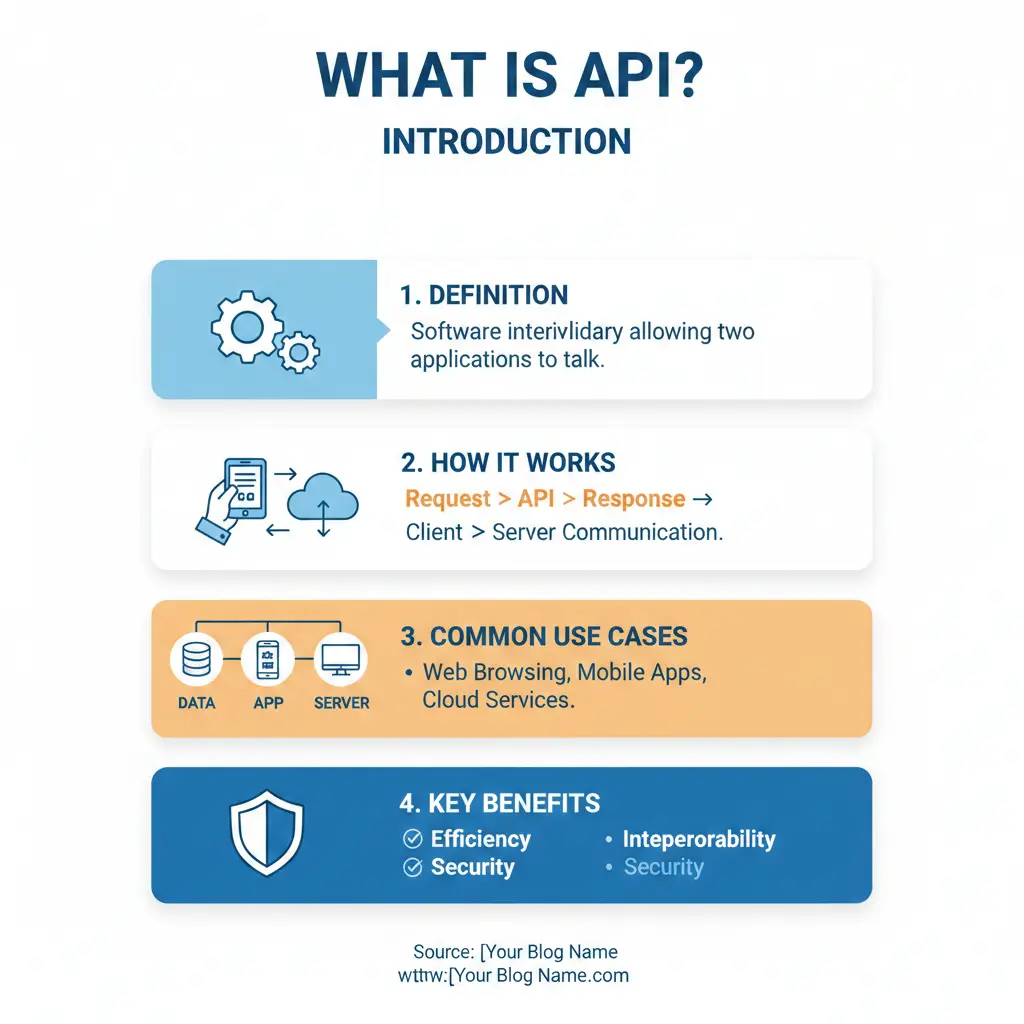
At a Glance — What is API (click to enlarge)
How APIs Work
Have you ever tried to integrate different software systems, only to find that they don't communicate with each other? You're not alone. Many developers and businesses face this challenge, and that's where APIs come in. Here's the part most people miss: understanding how APIs work is key to unlocking their full potential. An API, or Application Programming Interface, enables different systems to exchange data and functionality, allowing them to work together seamlessly.
When you make an API request, you're essentially asking a system to perform a specific task or provide certain data. The system then processes your request and sends a response, which can be in the form of data, an error message, or even a confirmation of the action taken. For example, when you use a travel website to book a flight, the website sends an API request to the airline's system to check availability and prices. The airline's system then responds with the requested information, which is displayed on the website.
API Protocols and Security
APIs use specific protocols, such as HTTP or HTTPS, to communicate with each other. These protocols define the rules for how data is exchanged, including the format of the request and response, and the security measures in place to protect the data. API security is a critical aspect of API design, as it ensures that sensitive data is protected from unauthorized access. One common approach to API security is to use API keys or access tokens, which are unique identifiers that authenticate the requester and authorize access to specific resources.
A real-world example of API security in action is the OAuth protocol, which is widely used in social media and online services. When you use a social media platform to log in to a third-party website, the website sends an API request to the social media platform's system, which responds with an authorization token. This token is then used to authenticate the user and authorize access to their profile information. By using OAuth, the website can ensure that the user's sensitive data is protected, while still allowing them to access the website's functionality.
Types of APIs
As you start exploring the world of APIs, you may find yourself overwhelmed by the numerous options available. You might be wondering which type of API to use for your specific project. And this is where things get practical. You see, different APIs are suited for different purposes, and understanding their differences is key to making an informed decision. For instance, let's consider a scenario where you're building a mobile app that needs to fetch data from a server. You'd want an API that's lightweight, flexible, and easy to implement.
A popular choice for such scenarios is the RESTful API. This type of API follows a set of principles that emphasize simplicity, scalability, and ease of use. RESTful APIs use standard HTTP methods like GET, POST, and PUT to interact with resources, making them a great fit for web-based applications. A real-world example of a RESTful API is the Twitter API, which allows developers to access Twitter data and functionality in a straightforward and efficient manner.
In contrast, SOAP APIs are more formal and rigid, relying on XML to define the structure of the data being exchanged. While they may seem more complex than RESTful APIs, SOAP APIs are often used in enterprise environments where security and reliability are top priorities. For example, a company like Amazon might use a SOAP API to integrate its e-commerce platform with a third-party payment gateway.
Another type of API that's gaining popularity is the GraphQL API. Developed by Facebook, GraphQL allows for more flexible and efficient data querying, reducing the amount of data transferred between the client and server. This makes it an attractive choice for applications with complex, dynamic data requirements. A case study that illustrates the benefits of GraphQL is the GitHub API, which uses GraphQL to provide a more intuitive and customizable interface for developers.
When choosing an API type, you should consider factors like the specific requirements of your project, the level of complexity you're willing to handle, and the trade-offs between flexibility and security. By understanding the strengths and weaknesses of each API type, you can make an informed decision that sets your project up for success.
Imagine you're building a website that allows users to share their favorite products on social media. You want to make it easy for them to post updates to their Facebook or Twitter feeds, but you don't want to require them to leave your site. This is a common pain point for many developers, as it requires integrating multiple systems and services. Let's shift gears for a moment. Instead of focusing on the technical challenges, let's look at how APIs can provide a solution.
One common use case for APIs is social media integration. For example, the Facebook Graph API allows developers to access Facebook data, such as user profiles and friends lists, and use it to create personalized experiences on their own websites. You can use this API to create a "share on Facebook" button that posts updates directly to a user's feed. This not only makes it easy for users to share content, but also helps to increase engagement and drive traffic to your site.
Another example of API usage is payment gateways. When you make an online purchase, the website you're buying from needs to communicate with the payment processor, such as Stripe or PayPal, to complete the transaction. This is typically done using an API, which allows the website to send payment information to the processor and receive a response indicating whether the payment was successful. For instance, you can use the Stripe API to create a custom payment form that integrates with your website, allowing you to accept payments from customers.
Weather APIs are another interesting example. These APIs provide access to current weather conditions and forecasts, which can be used to create all sorts of applications, from simple weather apps to complex systems for tracking climate patterns. For example, you can use the OpenWeatherMap API to create a website that displays the current weather for a given location, complete with temperature, humidity, and wind speed data. You can also use this data to create more complex applications, such as a system for tracking weather patterns and predicting future weather conditions.
As you can see, APIs are used in a wide range of applications, from social media integration to payment processing to weather forecasting. By providing a standardized way for systems to communicate with each other, APIs make it possible to create complex and powerful applications that can solve real-world problems. You can use APIs to create custom solutions that meet the specific needs of your business or organization, and to integrate with other services and systems to create a more seamless and efficient experience for your users.
Best Practices for API Development and Integration
Developers often struggle with creating and integrating APIs that are both efficient and secure. You may have experienced the frustration of dealing with poorly designed APIs that are difficult to work with, or worse, APIs that compromise the security of your application. A well-designed API can make all the difference in the success of your project.
When it comes to API design principles, simplicity and consistency are key. You want to make it easy for developers to understand and use your API, so keep your endpoints and methods organized and intuitive. For example, the RESTful API design pattern is widely adopted because of its simplicity and flexibility. Consider the case of Twitter's API, which uses a RESTful design to provide easy access to its data.
Security Measures
API security measures are also essential to prevent unauthorized access and data breaches. You can use OAuth 2.0 or JWT to authenticate and authorize API requests. Additionally, you should validate and sanitize all user input to prevent SQL injection and cross-site scripting attacks. Consider using a web application firewall to detect and prevent common web attacks.
When testing and debugging your API, you can use tools like Postman or cURL to simulate API requests and test your endpoints. You should also write unit tests to ensure your API is working as expected. For instance, you can use a testing framework like Jest to write unit tests for your API. By following these best practices, you can create a secure and efficient API that is easy to work with.
Empowered Connection
Many developers and businesses struggle to integrate different systems and services, leading to frustration and wasted time. By understanding what an API is and how it works, you can break down these barriers and unlock new possibilities. With this knowledge, you can start exploring APIs and their applications today, and discover how they can help you build more connected, efficient, and innovative solutions. What will you create by connecting the dots with APIs?
Frequently Asked Questions
Application Programming Interface
To allow different systems to communicate with each other