Export Boost Policies in Sri Lanka 2026: Government Incentives for Businesses

Sri Lanka's export sector is gearing up for a massive transformation in 2026, with bold government policies designed to slash barriers and supercharge your business's global reach. Whether you're a sm...
Sri Lanka's export sector is gearing up for a massive transformation in 2026, with bold government policies designed to slash barriers and supercharge your business's global reach. Whether you're a small tea exporter in the hills or running a garment factory in Katunayake, these Sri Lanka export policy changes and export incentives could be the game-changer you've been waiting for to hit new markets and boost revenues.
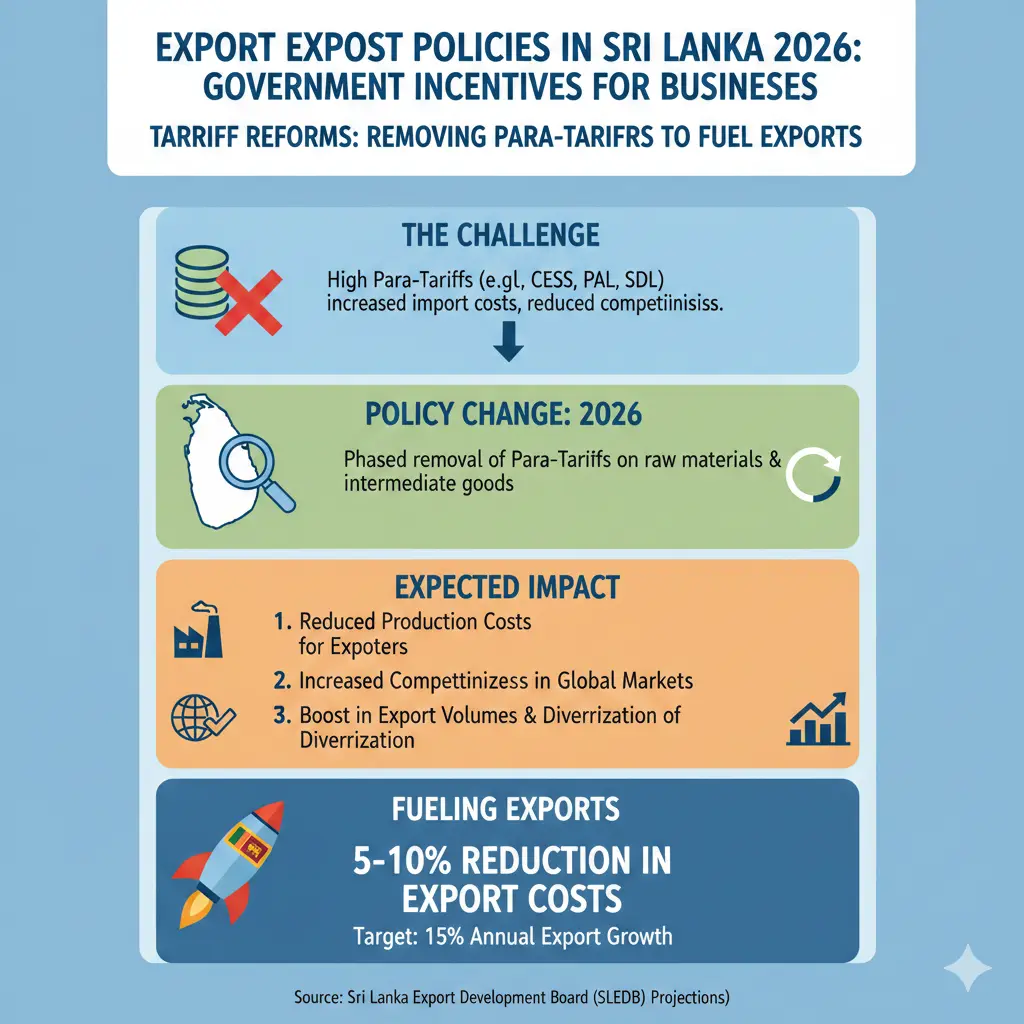
Tariff Reforms: Removing Para-Tariffs to Fuel Exports
One of the biggest shifts in 2026 is the removal of para-tariffs like cess and the Port and Airport Development Levy (PAL), announced by Deputy Minister of Industry Chathuranga Abeysinghe.[1][5] This isn't just paperwork—it's a direct cut to your import costs for raw materials, making Sri Lankan products cheaper to produce and more competitive worldwide.
Why does this matter for us? High para-tariffs have long jacked up costs for exporters reliant on imported inputs, like fabrics for apparel or machinery parts for electronics. By transitioning to a simpler four-category import tariff framework, the government aims to integrate our economy into global value chains.[1] Discussions with the World Bank are already underway to set national standards and block under-invoiced or low-quality imports, ensuring fair play for local businesses.[1]
How These Changes Impact Your Business
- Lower raw material costs: No more cess or PAL on key imports, directly boosting your margins.
- Export competitiveness: Cheaper production means you can undercut rivals in markets like the EU or US.[5]
- Trade agreement readiness: This reform is a must for new international deals, opening doors wider.[1]
Practical tip: If you're importing capital goods, check your eligibility now—these reforms kick in fully in 2026, so plan your next shipment to capitalise early.
Strategic Export Development Roadmap 2026-2030
The Export Development Board (EDB) is leading the charge with its National Export Development Roadmap 2026-2030, targeting a whopping US$36 billion in export revenue by 2030.[2] Hosted at a recent National Consultative Forum, this plan unites government heavyweights like the Central Bank Governor and ministers from Industry and Digital Economy.[2]
It's a whole-of-government push, emphasising institutional partnerships to revamp our export ecosystem. Key events like Sri Lanka Expo 2026 (June 18-21 at BMICH, Colombo) will spotlight our strengths in apparel, tea, spices, and emerging sectors like electronics.[2] Plus, the launch of the Export Performance Indicator tool gives you real-time data to track performance and make smart decisions.
Key Priorities in the Roadmap
- Diversify products: Move beyond apparel and tea into high-value areas like IT services and renewables.
- Boost infrastructure: Better ports and digital connectivity for seamless shipping.
- Stakeholder collaboration: Join forums to influence policies that suit your sector.[2]
For local exporters, this means actionable support: register with EDB today at www.srilankabusiness.com to access the roadmap and tools.
Tax Incentives and BOI Concessions for Exporters
Sri Lanka's export incentives are stacked in your favour, especially through the Board of Investment (BOI) and Inland Revenue Act. Export-oriented projects snag customs duty exemptions on capital goods and raw materials, plus VAT deferment.[3] For electrical and electronics exporters, it's even sweeter: no PAL or NBT on raw materials if your investment hits USD 500,000.[3]
Corporate income tax drops to a low 14% for predominantly export manufacturing, with accelerated capital allowances to write off assets faster.[3] Larger investments (over USD 3 million) qualify for tax holidays up to 10-25 years, depending on location and scale—Northern Province gets extra perks like 200% incentives.[3]
Breakdown of Key Export Incentives
| Investment Level | Tax Holiday Years | Incentive % | Northern Province Bonus |
|---|---|---|---|
| USD 3Mn - 100Mn | 10 | 100% | No |
| USD 100Mn - 1,000Mn | 10 | 150% | No |
| Over USD 1,000Mn | 25 | 150-200% | Yes |
These perks avoid double taxation and pair with FTAs for duty-free access.[3] Example: A Katunayake electronics firm importing components can defer VAT, pay 14% tax, and ship to the EU under GSP+ with zero tariffs.
Preferential Market Access via FTAs and Global Frameworks
Our Sri Lanka export policy leverages a web of FTAs: Indo-Sri Lanka FTA, Pakistan-Sri Lanka FTA, SAFTA, GSP+ for EU, and more like Singapore-Sri Lanka FTA.[3] These give preferential tariffs, making your spices zero-rated in India or apparel duty-free in Europe.
Looking ahead, engagement with the US Indo-Pacific Economic Framework (IPEF) could safeguard apparel exports and diversify supply chains.[4] Pillars on trade, supply chains, and clean economy align with our needs—think harmonised standards and FDI inflows. Sri Lanka's low tariffs and skilled workforce position us perfectly for US partners shifting from China.[4]
Actionable advice: Audit your products against GSP+ rules of origin via EDB—non-compliance costs sales. For IPEF, watch Ministry of Industry updates; joining could secure US market insurance.[4]
Sustainability and Clean Economy Incentives
Aligning with our Nationally Determined Contributions (NDCs) 2026-2035, export policies now reward green practices.[6] IPEF's clean economy pillar offers tech transfer for renewables, vital as we tackle climate goals amid fiscal recovery.[4] Exporters in solar components or eco-textiles get BOI boosts, tying into the US$36bn target.[2][6]
FAQ: Common Questions on Sri Lanka Export Incentives
Q1: Who qualifies for BOI export incentives?
A: Export-oriented projects with min. USD 500k investment for raw material exemptions; larger for tax holidays.[3]
Q2: When do para-tariff removals start?
A: Fully in 2026 as part of tariff reform.[1]
Q3: How do I access the Export Performance Indicator?
A: Via EDB portal—launched at the 2026 forum for data-driven decisions.[2]
Q4: Does GSP+ cover my products?
A: Yes for 66% of EU imports like apparel; check EDB for rules.[3]
Q5: What's the export revenue goal?
A: US$36 billion by 2030 per EDB Roadmap.[2]
Q6: How to join Sri Lanka Expo 2026?
A: Register at EDB site for BMICH event, June 18-21.[2]
Next Steps to Boost Your Exports
Don't wait—contact EDB at www.srilankabusiness.com for a free consultation on incentives. Review your supply chain for 2026 tariff changes, apply for BOI status if eligible, and scout FTAs for quick wins. With these policies, your business can ride the export wave to new heights. Track updates via the Ministry of Industry and join forums to stay ahead. Let's make 2026 our export breakthrough year!
Sources & References
- Sri Lanka to remove para-tariffs cess, PAL: Deputy Minister — economynext.com
- EDB Hosts National Consultative Forum on Strategic Export Development Roadmap 2026-2030 — srilankabusiness.com
- Benefits & Concessions - EDB Sri Lanka — srilankabusiness.com
- Geoeconomic Landscaping: Prospects of Sri Lanka's Engagement with the US Indo-Pacific Economic Framework — airuniversity.af.edu
- Budget 2026 - KPMG Analysis Key Insights (PDF) — assets.kpmg.com
- Sri Lanka's Nationally Determined Contributions 3.0 (2026-2035) (PDF) — unfccc.int
Related Articles
Sri Lanka IMF EFF Program 2026: Key Reforms and Impacts on Businesses
As we navigate 2026, Sri Lanka's IMF Extended Fund Facility (EFF) programme stands as a cornerstone of our economic revival, delivering vital funds and pushing through reforms that stabilise our finan...

How Sri Lanka's 2026 GDP Growth Forecast of 4-5% Affects Your Investments
Sri Lanka's economy is picking up speed, with the Central Bank forecasting a solid 4-5% GDP growth for 2026—good news for your savings, shares, and property investments.Sri Lanka GDP 2026 projections...

Sri Lanka Inflation Outlook 2026: Projections at 4.1% and Business Strategies
As we navigate 2026, Sri Lanka's inflation outlook points to a modest rise to around 4.1%, staying below the Central Bank's 5% target and paving the way for supportive monetary policies that benefit b...

Primary Surplus Targets in Sri Lanka 2026: IMF Compliance and Fiscal Impacts
Sri Lanka's commitment to maintaining a primary surplus of 2.3 percent of GDP through 2027 marks a critical turning point in the nation's fiscal recovery. This target, agreed with the International Mo...