Sri Lanka Inflation Outlook 2026: Projections at 4.1% and Business Strategies

As we navigate 2026, Sri Lanka's inflation outlook points to a modest rise to around 4.1%, staying below the Central Bank's 5% target and paving the way for supportive monetary policies that benefit b...
As we navigate 2026, Sri Lanka's inflation outlook points to a modest rise to around 4.1%, staying below the Central Bank's 5% target and paving the way for supportive monetary policies that benefit businesses and households alike.[1][2] This stability, amid recovering reserves and subdued global commodity prices, means we're in a stronger position to plan ahead—whether you're running a small shop in Colombo or managing a factory in the hill country.
Current Inflation Trends Heading into 2026
Sri Lanka's inflation has remained low through late 2025 and early 2026, providing a solid foundation for growth. In January 2026, annual inflation in Colombo reached 2.3%, up slightly from 2.1% in December 2025—the highest since July 2024 but still well-contained.[3] Food inflation ticked up to 3.3%, influenced by Cyclone Ditwah's short-term disruptions to crops and supply chains, yet prices have stabilised quickly.[2][3]
The Central Bank of Sri Lanka (CBSL) reports that inflation stayed subdued in 2025, enabling an accommodative monetary policy.[1] Gross official reserves hit over US$6.8 billion by end-2025, bolstered by CBSL's US$2 billion in net foreign exchange purchases and multilateral inflows.[1] This buffer supports exchange rate flexibility while building reserves to meet adequacy standards.
Key Drivers Keeping Inflation in Check
- Lower global commodity prices: A major factor projecting inflation at ~4.1% for 2026, even with a potential 10% electricity tariff hike factored in.[2]
- Stable currency and reserves: Manageable depreciation and strengthened macroeconomic buffers reduce imported inflation risks.[1][2]
- Post-cyclone recovery: Supply disruptions from Cyclone Ditwah proved short-lived, with food essentials stabilising swiftly.[2]
Trading Economics forecasts inflation at 2.5% by end-Q1 2026, trending to 3.4% in 2027 and 4% in 2028, aligning with CBSL's flexible inflation targeting framework.[3]
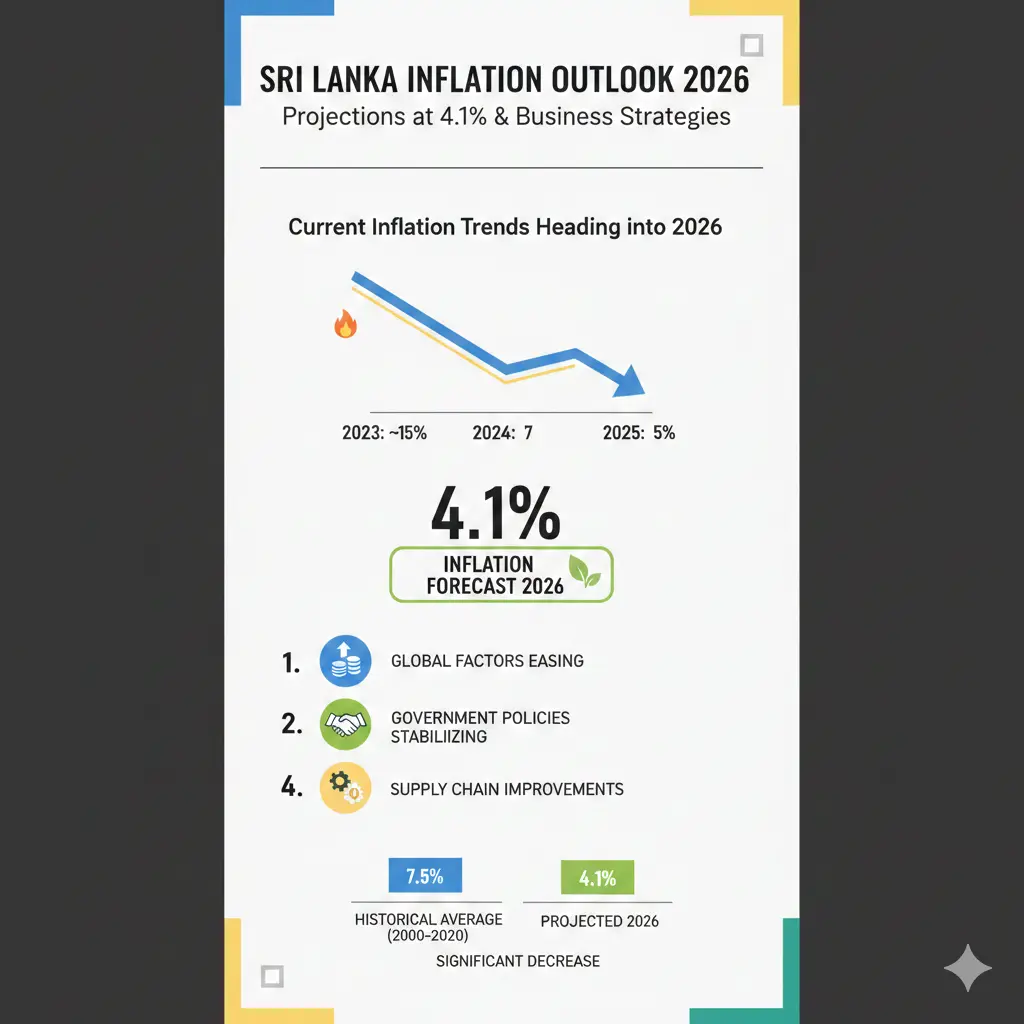
Sri Lanka Inflation Forecast for 2026: 4.1% Projection
Experts project Sri Lanka inflation 2026 at approximately 4.1%, rising gradually from 2025's average of -0.5% but remaining below the CBSL's 5% target by year-end.[1][2] CBSL Governor Nandalal Weerasinghe notes this uptick will return to target in the second half, supported by 4-5% economic growth, improved reserves, and low inflation.[1]
CAL Sri Lanka's analysis reinforces this inflation forecast, citing lower global commodities and stable rupee as anchors, even post-cyclone.[2] Upside risks include supply shocks or reconstruction demand after Cyclone Ditwah, while downside pressures could emerge if electricity tariffs stay flat.[1][2]
Policy Response: Rate Cuts on the Horizon
Low inflation enables CBSL to maintain its accommodative stance, with policy rates already lowered in line with regional trends.[1][4] This supports rate cuts, easing borrowing costs for businesses and consumers. Under the Monetary Law Act, CBSL targets price stability while fostering growth, publishing its policy agenda annually for transparency.[1]
For us in Sri Lanka, this means cheaper loans from banks like Commercial Bank or HNB, helping expand operations without crippling interest payments.
Business Strategies to Thrive Amid 4.1% Inflation
With Sri Lanka inflation 2026 forecast at 4.1%, businesses can plan confidently. Low inflation supports pricing stability, cost control, and investment—key for our post-crisis recovery.
Pricing and Cost Management Tips
- Lock in supplier contracts: Negotiate fixed-price deals for imports like fuel or fertiliser, hedging against any gradual rise.[2]
- Adjust pricing gradually: For retailers in Pettah or Kandy markets, pass on 2-3% hikes mid-year, aligning with the projected trajectory to target.[1]
- Monitor CEB tariffs: Budget for a possible 10% increase; if avoided, reinvest savings into stock.[2]
Investment and Expansion Opportunities
Leverage rate cuts for capital investments. Construction firms can tap low-cost loans for Cyclone Ditwah rebuilding, while exporters benefit from stable reserves.[1] Visit the Board of Investment (BOI) portal at investsrilanka.com for incentives in tourism or apparel.
- Diversify sourcing: Shift to local rice or vegetables post-cyclone lessons, reducing import reliance.
- Build cash buffers: Aim for 6-12 months' reserves, using CBSL's exchange flexibility.
- Digital tools: Use apps like PickMe or Uber for logistics cost-tracking in real-time.
Risk Mitigation for Local Enterprises
Small businesses in Galle or Jaffna should watch food inflation (currently 3.3%) via the Department of Census and Statistics dashboard at statistics.gov.lk.[3] Join the Chamber of Young Entrepreneurs (CYEN) for peer advice on navigating upside risks like geopolitical tensions.[1]
Table: Inflation Impact on Key Sectors
| Sector | 2026 Projection Impact | Strategy |
|---|---|---|
| Retail & Food | 3.3% food rise, stabilising | Local sourcing, dynamic pricing |
| Manufacturing | Low energy costs if tariffs flat | Export focus with reserves |
| Tourism | Stable rupee aids visitors | Invest in eco-resorts |
| Construction | Reconstruction demand | Secure BOI loans |
Household and Personal Finance Tips
For families, 4.1% inflation means budgeting for essentials rises modestly. Track via the CBSL website at cbsl.gov.lk.[1]
- Shop at Economic Centre for bulk deals.
- Fixed deposits at 8-10% beat inflation—check Peoples Bank rates.
- Avoid debt for non-essentials as rates may ease further.
FAQ: Sri Lanka Inflation 2026 Common Questions
Q1: Will inflation hit 5% in 2026?
A: Projections show ~4.1%, returning to CBSL's 5% target by H2, barring major shocks.[1][2]
Q2: How does Cyclone Ditwah affect the forecast?
A: Short-lived supply hits; prices stabilised, not altering the 4.1% outlook significantly.[2]
Q3: Are interest rate cuts coming?
A: Yes, low inflation supports easing, as in recent policy shifts.[1][4]
Q4: What's the best business move now?
A: Invest in growth via cheap loans; hedge costs with local suppliers.[1][2]
Q5: Where to check real-time data?
A: Department of Census and Statistics or CBSL sites for monthly updates.[1][3]
Q6: Long-term trend post-2026?
A: Around 3.4% in 2027, 4% in 2028 per models.[3]
Next Steps for Businesses and Households
Stay ahead by subscribing to CBSL's monthly reports and joining local chambers. Review your budgets quarterly, locking in rates before cuts materialise. With 4.1% inflation and 4-5% growth, 2026 offers stability—use it to build resilience against risks like global volatility.[1] Download the CBSL app or visit cbsl.gov.lk today for the latest.
Sources & References
- Sri Lanka expects 4-5 pct growth in 2026: central bank - Xinhua — english.news.cn
- Inflation Outlook & Price Stability | CAL Sri Lanka - YouTube — youtube.com
- Sri Lanka Inflation Rate - Trading Economics — tradingeconomics.com
- Global Economic Prospects -- January 2026 - The World Bank — ththedocs.worldbank.org
Useful Tools
Related Articles
Sri Lanka IMF EFF Program 2026: Key Reforms and Impacts on Businesses
As we navigate 2026, Sri Lanka's IMF Extended Fund Facility (EFF) programme stands as a cornerstone of our economic revival, delivering vital funds and pushing through reforms that stabilise our finan...

How Sri Lanka's 2026 GDP Growth Forecast of 4-5% Affects Your Investments
Sri Lanka's economy is picking up speed, with the Central Bank forecasting a solid 4-5% GDP growth for 2026—good news for your savings, shares, and property investments.Sri Lanka GDP 2026 projections...

Primary Surplus Targets in Sri Lanka 2026: IMF Compliance and Fiscal Impacts
Sri Lanka's commitment to maintaining a primary surplus of 2.3 percent of GDP through 2027 marks a critical turning point in the nation's fiscal recovery. This target, agreed with the International Mo...

Sri Lanka Foreign Reserves Update January 2026: Risks and Government Policy Responses
As we navigate 2026, Sri Lanka's foreign reserves have captured our attention with a slight dip in January, dipping to USD 6,824 million from USD 6,838 million the previous month.[1] This marginal dec...