How to Analyze Stocks for Beginners

If you're thinking about investing in stocks but don't know where to start, you're not alone. Many Sri Lankan investors feel overwhelmed by market jargon, complex charts, and endless investment options.
If you're thinking about investing in stocks but don't know where to start, you're not alone. Many Sri Lankan investors feel overwhelmed by market jargon, complex charts, and endless investment options. The good news? Learning to analyse stocks doesn't require a finance degree. With the right framework and a bit of practice, you can make informed investment decisions that align with your financial goals.
Understanding Stock Analysis: The Foundation
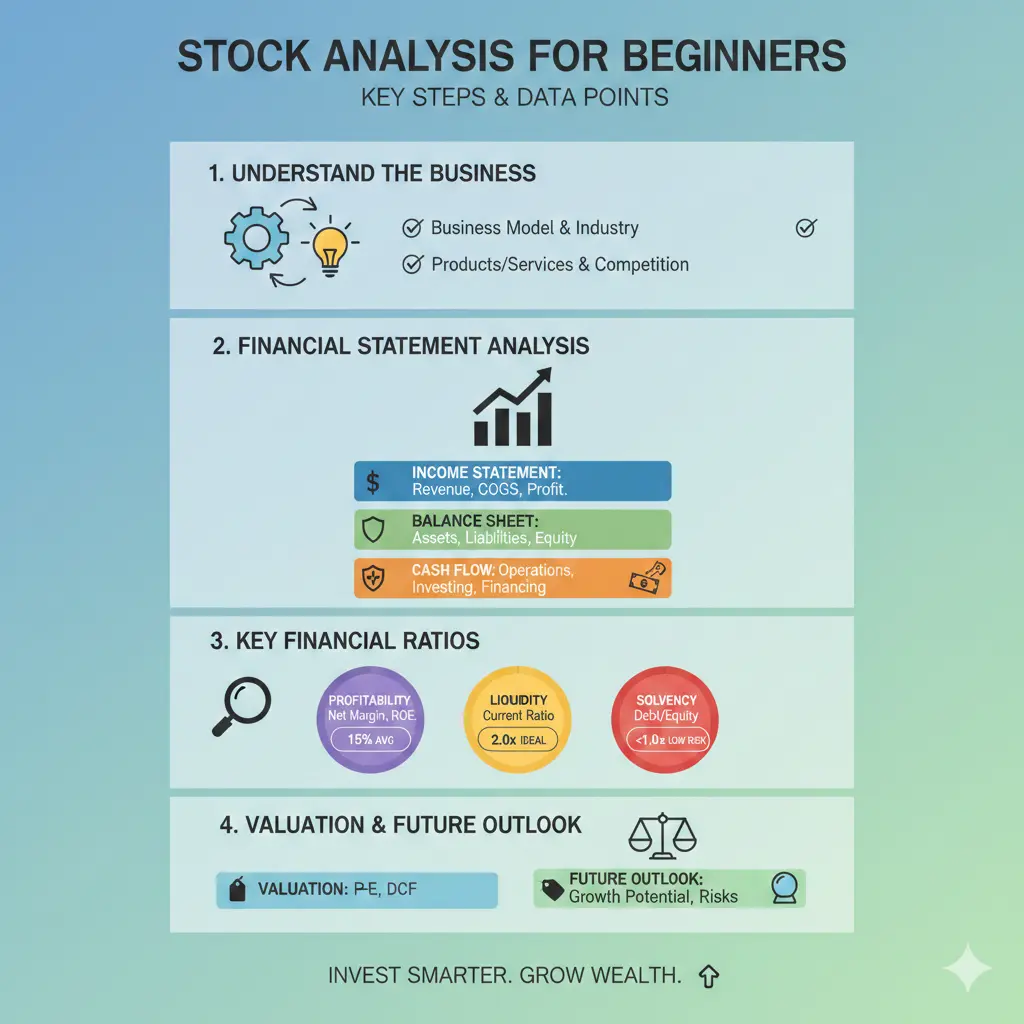
Stock analysis is essentially the process of evaluating a company's financial health and potential to help you decide whether to buy, hold, or sell its shares. There are three main approaches to analysing stocks, each with its own strengths and weaknesses.[1]
Think of stock analysis like evaluating a property before purchase. You wouldn't just look at the asking price—you'd check the neighbourhood, the building's condition, rental potential, and market trends. Stock analysis works the same way.
The Three Main Methods of Stock Analysis
1. Fundamental Analysis: Digging Into the Numbers
Fundamental analysis evaluates a company's intrinsic value by examining its financial statements, economic conditions, and industry performance.[1] This method helps you identify whether a stock is undervalued, overvalued, or fairly priced.
When you use fundamental analysis, you're asking: "Is this company actually worth what the market is charging for it?"
Key metrics to focus on include:
- Earnings and revenue—indicators of a company's profitability and growth potential[1]
- Debt levels—a measure of financial stability and risk[1]
- Price-to-earnings (P/E) ratio—a benchmark for a stock's value[1]
- Cash flow—whether the company generates actual cash from operations
- Assets and liabilities—the company's overall financial position
For example, if a Sri Lankan bank is trading at a low P/E ratio compared to its competitors, fundamental analysis would help you determine whether that's because it's undervalued or because the market has legitimate concerns about its future performance.
2. Technical Analysis: Reading Price Patterns
Technical analysis examines historical price movements and trading volumes to predict future stock performance.[1] Rather than focusing on a company's financials, this approach relies on patterns and trends in market data.
Technical analysts believe that historical price patterns repeat, and by identifying these patterns, you can anticipate future price movements.
Common tools used in technical analysis include:[1]
- Moving averages—a tool for smoothing out price data to spot overall trends
- Relative strength index (RSI)—a momentum indicator that measures the speed and change of price movements
- Candlestick patterns—visual representations of price action over specific periods
A word of caution: beginners often get caught up collecting dozens of indicators (RSI, MACD, Stochastics, Ichimoku, and more). The reality is simpler—you don't need them all to start.[4] A clean chart with key price levels and moving averages is enough for most beginner traders.
3. Sentiment Analysis: Understanding Market Mood
Sentiment analysis assesses the mood and opinions of market participants, which can influence stock prices.[1] By analysing news, social media, and investor behaviour, you can pick up on shifts in market optimism or fear.
Market sentiment drives demand and supply dynamics. Positive sentiment can drive prices up, whilst negative sentiment might trigger investors to sell off their holdings.[1] Understanding sentiment can give you an edge in anticipating market movements, especially during volatile periods.
Which Method Should You Choose?
The answer depends on your investment style and goals:
- Fundamental analysis suits long-term investors who want to build wealth steadily. It's ideal if you're planning to hold stocks for years and aren't concerned with short-term price fluctuations.
- Technical analysis works better for traders who want to profit from short-term price movements and market trends.
- Sentiment analysis complements both approaches by helping you understand when markets might be overreacting to news.
For most beginners in Sri Lanka, fundamental investing combined with a long-term "buy and hold" strategy is recommended.[2] This approach requires less constant monitoring and emotional discipline.
Practical Steps to Get Started
Step 1: Choose Your Analysis Method
Decide whether you want to focus on fundamental or technical analysis. Most beginners benefit from starting with fundamentals because it's more straightforward and aligns with long-term wealth building.
Step 2: Gather Reliable Data
You'll need access to company financial statements, stock prices, and market news. In Sri Lanka, the Colombo Stock Exchange (CSE) website provides official stock information, financial reports, and trading data. Many international platforms like Yahoo Finance, Google Finance, and Morningstar also offer free stock data.[1]
Step 3: Learn Key Metrics
Don't try to master everything at once. Start with three to five key metrics relevant to your chosen analysis method. Practice calculating and interpreting these metrics with stocks you're genuinely interested in.
Step 4: Use Dollar-Cost Averaging
Rather than trying to time the market perfectly, invest a fixed amount regularly (e.g., Rs. 5,000 every month) regardless of market conditions.[6] This strategy transforms market volatility from an enemy into an ally. When prices drop, your fixed contribution buys more shares. When prices rise, you buy fewer shares. Over time, this averages out your cost per share.[6]
Step 5: Write Rules for Market Volatility
Market corrections are inevitable. The S&P 500 has experienced 56 corrections since 1929, with only 22 turning into bear markets (20%+ declines).[6] Write simple behavioural rules now, while markets are calm: "I won't check my balance more than once per month," or "I'll continue automated deposits through any decline under 20%."[6]
Step 6: Risk Management
Never risk more than 1–2% of your trading account on a single trade.[4] This protects you from emotional instability and the devastating possibility of losing your entire investment.
Common Mistakes Beginners Make
- Overcomplicating analysis—using too many indicators or metrics at once
- Emotional decision-making—buying and selling based on fear or greed rather than analysis
- Ignoring fees and costs—not accounting for brokerage fees, taxes, and hidden charges
- Trying to time the market—waiting for the "perfect" entry point instead of investing consistently
- Insufficient backtesting—testing a strategy on fewer than 50–100 trades before committing real money[4]
Stock Analysis for Sri Lankan Investors
If you're investing through the Colombo Stock Exchange, the same analysis principles apply. Sri Lankan listed companies publish annual and quarterly reports that contain the financial data you need for fundamental analysis. Sectors like banking, retail, and manufacturing are well-represented on the CSE, offering diverse opportunities for analysis practice.
When analysing Sri Lankan stocks, also consider local economic factors: currency fluctuations, interest rates set by the Central Bank of Sri Lanka, and sector-specific regulations. A company's fundamentals might look solid, but if the rupee is depreciating significantly, export-focused companies might face headwinds.
Frequently Asked Questions
Q: How long does it take to become good at stock analysis?
There's no fixed timeline. You can learn the basics in a few weeks, but true competence develops through consistent practice over months or years. Most successful investors spend years refining their skills.
Q: Do I need expensive software to analyse stocks?
No. Free tools like Yahoo Finance, Google Finance, and the CSE website provide all the data you need to get started. Paid platforms offer additional features, but they're not necessary for beginners.
Q: Should I analyse every stock before investing?
Yes, especially when you're learning. However, as you gain experience, many investors use simpler strategies like index funds or ETFs, which don't require individual stock analysis.
Q: Can I make money using only technical analysis?
Yes, but it's riskier for beginners. Technical analysis requires discipline, emotional control, and extensive backtesting. Most beginners find fundamental investing safer and more straightforward.
Q: What's the difference between stock analysis and stock picking?
Stock analysis is the process of evaluating stocks. Stock picking is using that analysis to select specific stocks to buy. Good analysis doesn't guarantee good picks, but it significantly improves your odds.
Q: How often should I re-analyse my stocks?
For long-term investors, quarterly reviews (when companies release earnings reports) are usually sufficient. For active traders, daily or weekly reviews might be necessary. Find a rhythm that suits your investment style without becoming obsessive.
Your Next Steps
Start small and build your skills gradually. Choose one analysis method, pick one or two stocks you're genuinely interested in, and practise calculating key metrics. Don't rush into real money investing until you feel confident in your analysis process.
Remember: the goal isn't to predict the future perfectly. It's to make informed decisions based on available data, manage your risk carefully, and stay disciplined through market ups and downs. With consistent practice and the right mindset, you'll develop the ability to analyse stocks effectively and build a stronger investment portfolio.
Sources & References
- The Comprehensive Guide to Stock Market Analysis - N26
- Stock Market for Beginners 2025/2026 – The Ultimate Investing Guide - YouTube
- Best Beginner Stock Market Courses & Certificates [2026] - Coursera
- Beginner Trading Master Guide 2026: The Complete Roadmap - ACY
- Stock Market for Beginners: How To Invest in 2026! - YouTube
- How to start investing in the stock market in 2026 without panic - FinHabits
Related Articles

How to Negotiate Credit Card Debt
Did you know that over 40% of Americans carry credit card debt from month to month? This staggering statistic is a sobering reminder that managing credit card debt is a challenge many of us face. I've seen it firsthand - a friend of mine was struggling to pay off a balance of over $10,000, with int...

Best Retirement Accounts for Self-Employed
If you're self-employed in Sri Lanka, you're responsible for your own retirement planning—and that's both a challenge and an opportunity.

Cryptocurrency Trading for Beginners
A staggering 27% of millennials prefer investing in cryptocurrencies over traditional stocks, according to a Charles Schwab survey. This shift in investment preferences is not surprising, given the potential for high returns in the cryptocurrency market. If you're considering joining the ranks of c...

Best Bitcoin Wallets 2026
What Is a Bitcoin Wallet and Why Does It Matter? A Bitcoin wallet is software or hardware that stores your private keys—essentially the passwords that prove you own your cryptocurrency.